

Antique Stitch
See Roumanian stitch.
Drawn Element Work
See drawn thread work.
Coggeshall Tambour Lace
See Coggeshall lace.
Canopy of Estate (UK)
See Cloth of State.
Cloth of Estate (UK)
See Cloth of State.
Canopy of State (UK)
See Cloth of State.
Tapestry
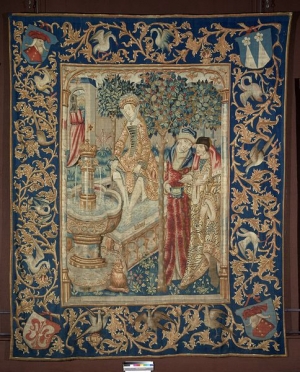
Tapestry is a heavy, handwoven cloth with designs made by separate weft threads that interweave only with the warp when required for the pattern. The binding is usually tabby and weft-faced, and the weft threads are usually of different colours. As most tapestries are woven on looms without a beater, the wefts do not have to lie strictly at right angles to the warp threads. Instead they may follow the contours of the design much more freely.
Linen
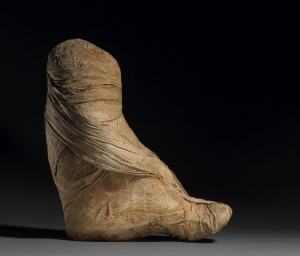
Linen is a term used to describe both the thread and any cloth made from flax. Flax is a bast fibre obtained from the stem of a plant of the Linaceae family (Linum, especially Linum usitatissimum). Examples of linen cloth have been found at various archaeological sites that date back to at least the fifth millennium BC (from the Middle Eastern sites of Nahal and Çatal Hüyük) and the use of linen may have started even earlier.
Picot

Picot is the term for a series of small loops (also known as bobs) along the edge of a fabric or piece of lace. Picot can be made as part of the main fabric or produced separately and then sewn onto the ground. The word picot derives from the French pic, meaning to peak, point or prick. Picot is sometimes regarded as a (simple) form of embroidered lace.
Slanting Blanket Stitch
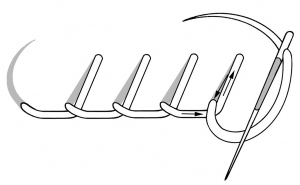
A slanting blanket stitch is a form of blanket stitch, but instead of the upright elements of the stitch being straight they slant slightly to one side.