

Queen Ann Stitch
See weaving stitch.
Weaving Stitch
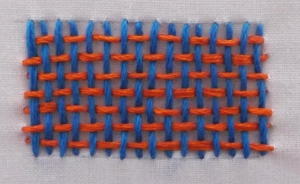
The weaving stitch is also known as the Queen Anne stitch or the woven filling stitch, and is a form of darning stitch, which can be used instead of a satin stitch. Stitches are made in horizontal or vertical, parallel lines. Then other stitches are made vertically or horizontally, weaving through the horizontal/vertical stitches at a straight angle.
Ukrainian embroidery
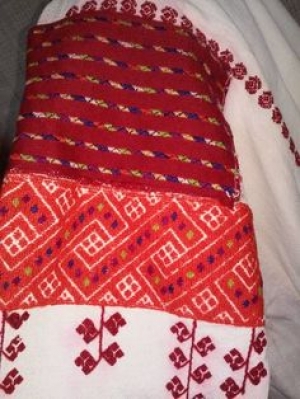
Ukrainian women have been working embroidery for centuries. The country harbours various traditions, some of them closely linked to embroideries of Russia further to the east and north; others more linked to East and Southeast European embroideries.
Krestetsky embroidery
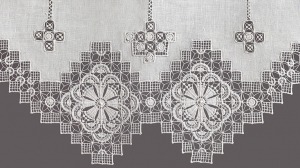
Krestetsky embroidery originates from the Krestetsky district, in the Novgorod Oblast, between St Petersburg and Moscow. This form of embroidery has over the years become famous in Russia and beyond. It is sometimes described as Krestetsky whitework, or Krestetsky flaxen work. It may be classed as a form of embroidered lace.
Royal Textile Academy of Bhutan

The Royal Textile Academy of Bhutan, also known as the Bhutan Textile Museum or the National Textile Museum, was established in 2001. It was set up to promote Bhutan's textile arts and to serve the interests of the weavers in order to preserve traditional textile patterns. The academy and museum want to become the centre for textile studies and research.
Hungarian Cushion Cover

The Textile Research Centre (TRC), Leiden, houses an embroidered cushion cover from Hungary, which dates to the late twentieth century. It measures 48 x 41 cm. It is made from linen with cotton embroidery threads.
Embroidered Picture from Finland, 1950's

The Victoria and Albert Museum in London houses an embroidered picture from Finland, dating to the 1950's, that is made of jute and embroidered with silk and metal threads with running stitch and stem stitches and couching. The embroidery measures 15.3 x 21 cm. The decoration represents a stag, dove, heart, tree and star.
Fashion Plate, Russia, 1834
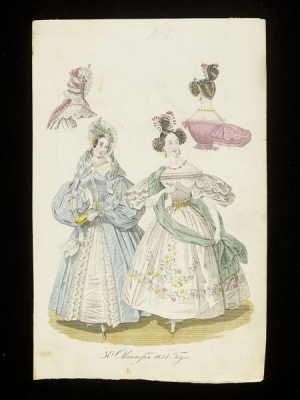
This fashion plate was published in St Petersburg in October 1834 and shows the latest (Parisian?) fashions in ladies wear, including a white ballgown with embroidered floral motifs on the skirt and sleeves.
Separate Pocket from Russia

The collection of the Victoria and Albert Museum in London includes a pocket that dates to the early nineteenth century and was made in Russia. The ground material is made of linen and silk, sewn by hand with silk and linen, and embroidered with silk thread. It was acquired for the V&A in 1907, perhaps together with the towel end with bobbin lace.
Embroidered Panel from Russia
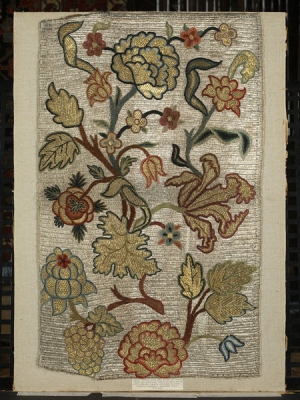
The Victoria and Albert Museum in London houses an embroidered panel from Russia, dating to c. 1700. It measures 71.2 x 43.2 cm. The ground material is made of silver thread and cotton, and the embroidery is worked in couched silver-gilt thread and chenille silks. The embroidery includes floral motifs and a bunch of grapes.