

Trousers for a Zoroastrian Woman
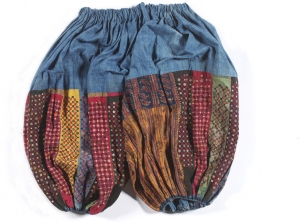
The Victoria and Albert Museum in London holds a pair of cotton, silk embroidered trousers that date to the mid-nineteenth century and originate from the Zoroastrian community in Iran, and allegedly from the town of Yazd, which is still populated by a large group of adherents of the ancient faith of Zarathustra, also known in the West as Zoroaster.
In Praise of God exhibition, Vienna, 2016.

'In Praise of God: Ecclesiastical Textiles from the Age of Maria Theresia,' was the name of an exhibition set up in the Kaiserliche Schatzkammer in Vienna, from May to September 2016. On display were eighteenth century vestments from the collection of the museum. Most of the garments were owned by Emperor Charles VI (1685–1740), his wife Elisabeth Christine (1691–1750) and their daughter, Maria Theresia (1717–1780).
Thai Phra Rajaniyom
Condensed Scotch Stitch
Reversed Cushion Stitch
See cushion stitch.
Scotch Stitch
See cushion stitch.
Cushion Stitch
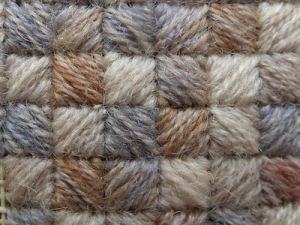
Also known as the Scotch or Scottish stitch, this technique is basically a stitch formation and a form of diagonal stitch. It is formed by a series of straight stitches of varying lengths worked diagonally across the ground material, thus forming a square. An alternating or reversed cushion stitch is comparable, but the diagonal stitches are worked in alternating directions.
Reversed Mosaic Stitch
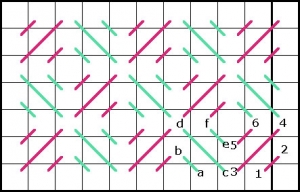
The reversed mosaic stitch is comparable to the diagonal mosaic stitch, but different cells of three stitches (two short diagonal stitches flanking a large diagonal stitch) are worked in opposite direction to each other.
Diagonal Mosaic Stitch
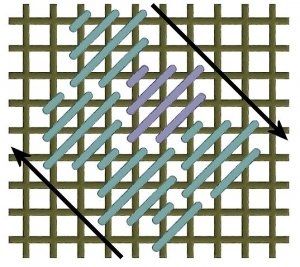
The diagonal mosaic stitch is a very simple form of diagonal stitch, built up of two short, diagonal stitches flanking one larger, diagonal one. When applied vertically, it is called the Hungarian stitch. Also known as the condensed Scotch stitch.
Plaited Braid Stitch
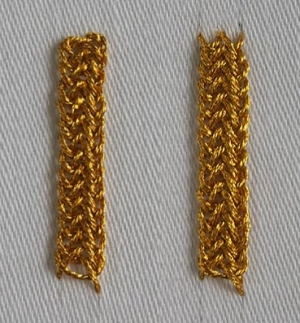
The plaited braid stitch is a complex stitch with loops, which creates a wide border. It is worked downwards, and to achieve the desired effect, a heavier thread should be used. While working, the loops can temporarily be pinned in place.