

Bed cover (China/Portugal)

A Chinese bed cover now in the Victoria and Albert Museum appears to have been produced in China for the export market. It dates to sometime between 1550 and 1750. Although now of a vermillion colour, originally it must have had a brightly red ground material. The cover shows a large degree of Portuguese influence. It measures 259 x 208 cm.
Museum Schaustickerei

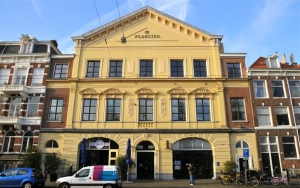
The Museum Schaustickerei in Plauen, Germany, houses a large collection of embroidery machines. Plauen is the city where the first hand-embroidery machine was developed that produced tulle lace (in 1881). The museum is housed in a former factory building where machine made embroidery was produced since 1889.
Nyonya Needlework Exhibition
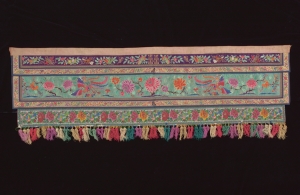
"Nyonya Needlework: Embroidery and Beadwork in the Peranakan World" is the title of an exhition that was on display from 24th June 2016 until March 2017 at the Peranakan Museum in Singapore. This exhibition celebrated the art of Nyonya ('women's') needlework, a vibrant part of Peranakan Chinese heritage.
Verzetsmuseum Amsterdam
The Resistance Museum (Verzetsmuseum) Amsterdam houses a number of special objects that are closely related to the war-time period of German occupation of The Netherlands between 1940 and 1945. Some of these objects were on display at the 2012 exhibition Elke dag een draadje …Borduren in gevangenschap 1940-1945 ('Everyday a little thread. Embroidering in prison, 1940-1945').
Needlework Mirror dated 1660
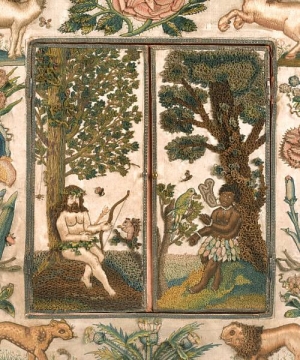
A needlework mirror with folding shutters was auctioned at Bonhams, London, in 2011. It dates to around 1660, was made in England and measures 38 x 35 cm. It is set in a tortoise shell and ebonised frame. The ground material is made of silk. The embroidery is worked in coloured silks and metal thread, using needlelace and other forms of needlework.
King Charles II and Catherine of Braganza

This cushion shows King Charles II and his wife, Queen Catherine of Braganza, together with allegories of the four continents (Africa, America, Asia and Europe). The cushion, now in the Metropolitan Museum of Art, New York, measures 20.3 x 80 x 68.6 cm. It was made after AD 1662, and embroidered in silk on a silk background, with beading.
The Lacemaker, by Johannes Vermeer

The Lacemaker (De Kantwerkster; La dentellière)) is a painting by the Dutch master, Johannes Vermeer (1632-1675), from about 1670. It measures 24.5 x 21 cm and since 1870 has been housed in the Musée du Louvre, Paris. The painting shows a young woman diligently at work on her piece of bobbin lace.
Hawthorne & Heaney
Hawthorne & Heaney is a company operating from a studio in London, specialising in the design and production of (hand) embroideries for a broad range of purposes, including haute couture and military. The firm was set up by Claire Barrett after she left the firm of Hand & Lock in 2011.
Burse Panel
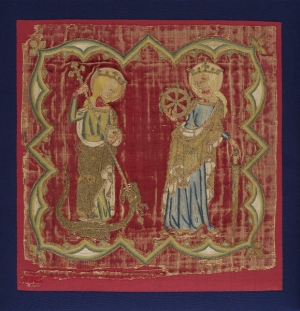
A fragment of a red silk velvet burse decorated in what is known as Opus Anglicanum is housed in the Victoria and Albert Museum, London. The panel measures 27.7 x 28.2 cm and is embroidered with silver and silver-gilt thread and silk. The V&A catalogue dates this panel to the years 1320-1340.
Robe for a Noh Theatre Actor (Japan)

The Noh theatre in Japan was developed in the fourteenth century and reached its classical form some centuries later. It is marked by its austerity, understatement and frugality of expression. No actors were often wearing special garments called atsuita. These were worn under kariginu robes by the (male) actors. The decoration of the atsuita was often rather simple, since very little could be seen by the audience.