

Lacemaker with a Boy Blowing Bubbles
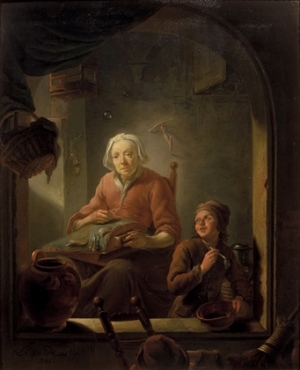
The oil on canvas 'A Lacemaker, with a Boy Blowing Bubbles' (De Kantwerkster / Kantklossende Vrouw en Bellenblazende Jongen) was painted in 1742 by the Dutch eighteenth century master, Louis de Moni (1698-1771). It is now part of the Mauritshuis collection in The Hague, and on long-term loan to the Museum De Lakenhal, Leiden, the town where De Moni eventually settled and spent the rest of his life.
Susanna van Collen-Mogge and her Daughter
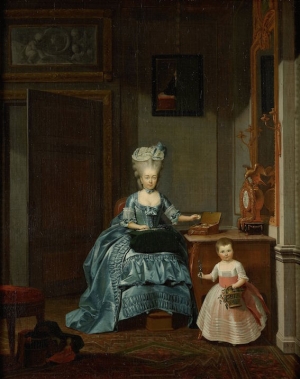
This oil on canvas painting from 1776 by the Dutch artist, Hermanus Numan (1744-1820), shows Susanna van Collen-Mogge and her daughter, Johanna Ferdinanda (1774-1833). The painting measures 80 × 64 cm. The woman is shown making bobbin lace using a flat pillow resting on a support of some kind. There is a sewing box on the table.
Fair Lady Working Her Tambour
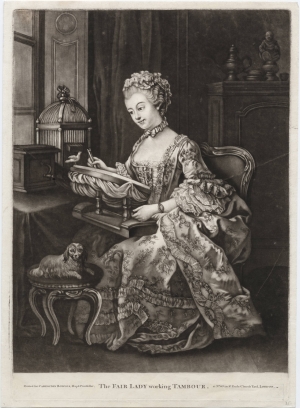
The Fair Lady Working Her Tambour is the title of a mezzo print dating to about 1764. It shows a woman at her tambour embroidery and behind her tambour frame, holding a tambour hook in her right hand.
Ladies Waldegrave
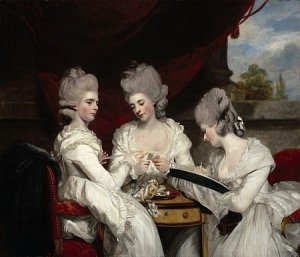
'The Ladies Waldegrave' was painted by Sir Joshua Reynolds (1723-1792) in 1780. Now in the Scottish National Gallery, it shows the three daughters of the 2nd Earl Waldegrave (1715-1763) together working their embroidery. The painting, without the frame, measures 143 x 168.30 cm.
Madame de Pompadour at her Tambour Frame
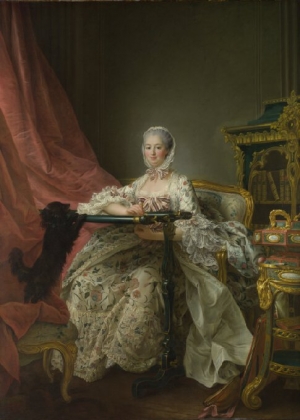
'Madame de Pompadour at her Tambour Frame' is an oil on canvas painting by François-Hubert Drouais (1727-1775), now housed in the National Gallery, London. Drouais was the main portrait painter at the court of Louis XV. He made this painting of Madame de Pompadour in 1763/4 and completed it after her death in the spring of 1764.
Embroidery Workshop
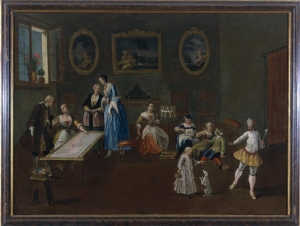
'The Embroidery Workshop' is an oil painting by Pietro Longhi (1701/2-1785; aka Pietro Falca), now in the Museo Correr in Venice. It shows a group of women being engaged in various activities related to embroidery.
French Embroidery Frame (18th Century)
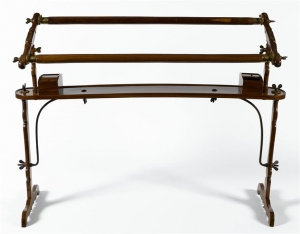
A mid-eighteenth century embroidery frame from France is housed in the Palais de Versailles (V 6144). It is 80 cm high, 116 cm wide and 45 cm deep. It is made of rosewood. It is a professional type, the angle of work can easily be altered. The two boxes are probably for storing threads and equipment.
Embroidery Lessons
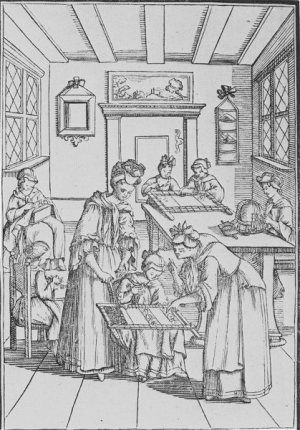
This engraving by the German craftsman, Elias Porzelius (1662-1722), dates to 1689. It is called the Embroidery Lessons, or the Embroidery School. It shows a group of women and girls engaged in various forms of embroidery.
Brodeur (gold thread embroidery)
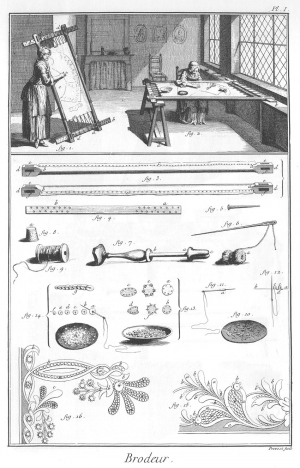
'Brodeur' is the title of a page taken from Denis Diderot (1713-1784) and Jean le Rond d'Alembert's Encyclopédie, ou dictionnaire raisonné des sciences, des arts et des métiers (1751-1772). The engraver of this particular panel is Robert Bénard (1734-1777). It is one of a series of two copper plate engravings dedicated to the craft of embroidery.
Brodeur (tambour embroidery)
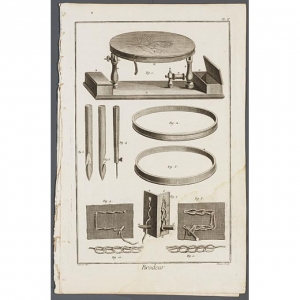
'Brodeur' is the title of a page taken from Denis Diderot (1713-1784) and Jean le Rond d'Alembert's Encyclopédie, ou dictionnaire raisonné des sciences, des arts et des métiers (1751-1772). The engraver of this particular panel is Robert Bénard (1734-1777). This panel is one of a series of two copperplate engravings dedicated to the craft of embroidery.