

Fashion Museum, Bath, England
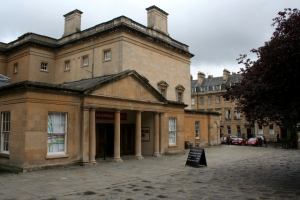
The Fashion Museum started its life as the Museum of Costume, which was opened on 23 May 1963. It is based on the collection of Doris Langley Moore designer, author and collector. The Museum changed its name to the Fashion Museum in 2007. It is housed in the Assembly Rooms in Bath, England. It focuses on historical, fashionable items of dress from Europe.
Lady Carrying a Balantine Handbag
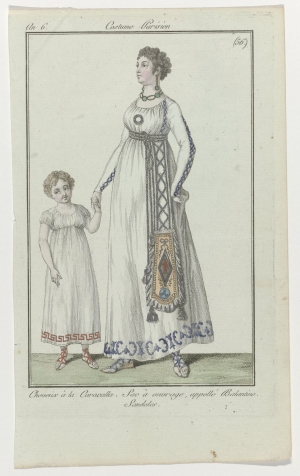
A lady carrying a decorated (embroidered?) balantine, which is a women's handbag suspended from a long cord from the belt and swinging back and forth at knee-height, is illustrated in the 17th August 1798 issue of the Journal des Dames et des Modes (Paris, 1797-1839).
Lady Carrying a Reticule
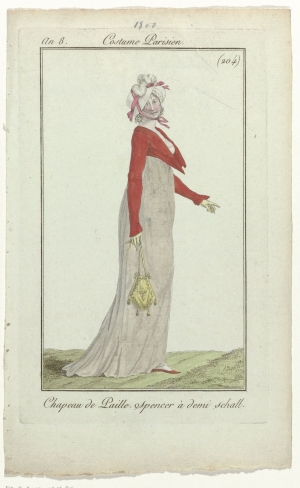
The 31 March 1800 issue of the Journal des Dames et des Modes contains an illustration of a lady dressed according to the latest Parisien fashion, and carrying a reticule, or small handbag, which was often delicately embroidered. The illustration is entitled 'Costume Parisien'. The journal was published in Paris between 1797 and 1839.
High-Heeled Women's Shoes from the Netherlands, c. AD 1700
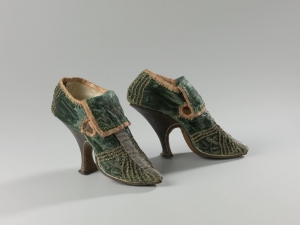
The Rijksmuseum in Amsterdam houses a pair of high-heeled, leather and green velvet shoes that date to c. 1700 and were made in The Netherlands. They are decorated with silver thread passementerie and floral motifs embroidered with silver thread. The shoes measure 21.8 x 7.7 cm. The heels are 9.5 cm high.
Embroidered Puppet Shoes from 19th Century Holland

The Rijksmuseum in Amsterdam houses a pair of leather and open-weave linen shoes (8.5 x 3 cm) that date to the first half of the nineteenth century (c. 1825-1850). The uppers of the shoes are embroidered with flowers and branches. The embroidery is carried out in tent stitch (or possibly cross stitch). The shoes have a flat sole (no heels) and square toes. The upper edge of the inside of the shoe is strengthened with a tape.
Ornamented Women's Shoes from 19th Century England

A pair of decorated women's shoes made of linen and dating to the 1840's or 1850's, is housed in the Victoria and Albert Museum, London. The shoes have a square toe, and the upper and tongue are ornamented with a red silk trim and glass beads.
Embroidered Shoes from Medieval Egypt

The Victoria and Albert Museum in London houses a pair of remarkably well-preserved leather shoes from medieval Egypt. The shoes, which originally may have been purple or red, are decorated with gilding (gold leaf) and embroidery, using linen and silk (?) thread. The shoes measure 26 x 8 cm, with a height of 7 cm.
Knotting Bag
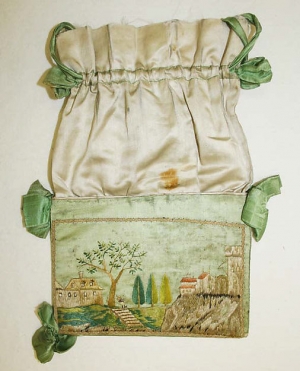
In the seventeenth, and especially in the eighteenth centuries, knotting was a popular pastime for ladies. They would also sometimes walk around with a nice small bag with a drawstring, held from their wrist, that contained shuttle and thread, and braids in various stages of completion.
Reticule

A reticule (knicknamed a ridicule in France) is the name for a small, woman's handbag, popular at the very end of the eighteenth and in the early nineteenth centuries, and Britain especially linked to the Regency period in England. The bags were mostly made of silk, and after about 1810 also of velvet. They could also be made of knitted fabrics.
Treasures from the Cope Chest, Lancaster Cathedral 2011

'Treasures from the Cope Chest' was the title of an exhibition at Lancaster Cathedral (29 June -17 July 2011), which had the subtitle 'An Exhibition of Liturgical Vestments Past and Present'. The exhibition included a wide range of ecclesiastical garments worn by catholic clergy throughout the centuries.