

Crewel Work Bed Hanging
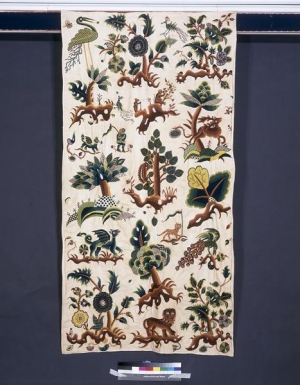
The Victoria and Albert Museum, London, houses a set of ten bed hangings made and decorated for a full-tester bed. They were made in England and date to the late seventeenth century and were embroidered in crewel work by Abigail Pett, whose name is added to one of the hangings.
Panel with Leek Embroidery
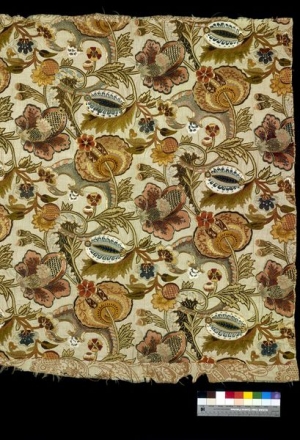
A fine example of Leek embroidery is held in the Victoria and Albert Museum, London. Leek embroidery, promoted by the Leek Embroidery Society, which was founded in 1879/1880 by Elizabeth Wardle, is characterised by embroidery being worked over a printed ground material.
Eating cloth from Afghanistan
The British Museum, London, holds a long piece of embroidered cloth, some 6.5 by 1 m, which is described as a table cover or a floor mat, but which may be a kamarband, a traditional stretch of cloth wound around the waist. The ground material is cotton, and the embroidery is carried out in chain stitch with an ari hook, using silk thread.
Layman's Hat (Tibet)
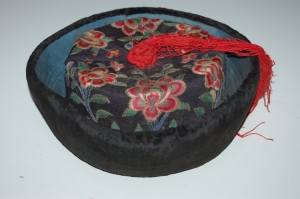
A hat with upturned rim, acquired in Tibet in 1905, worn by a layman and dating to the late nineteenth and early twentieth centuries, is housed in the British Museum, London. The crown is made of overlapping blue and black silk, with polychrome floral silk embroidery.
Embroidered Hand Cloth (Bhutan)
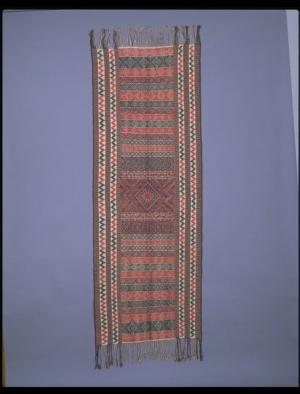
An embroidered hand cloth from Bhutan, localled called a chaksi pangkheb, dating to about 1900, is housed in the Victoria and Albert Museum, London. It is made of cotton with cotton and silk embroidery in darning stitch. This cloth was traditionally used for visitors to dry their hands. The cloth is almost 1.5 m long.
Lap Cloth (Bhutan)
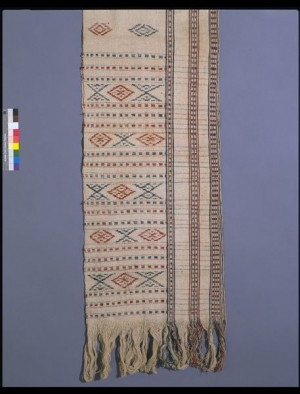
The Victoria and Albert Museum in London houses a lap cloth (localled called pangkheb) from Bhutan. It is made of unbleached cotton with woven and embroidered geometrical patterns in terracotta and indigo-coloured cotton threads. It is almost 2.5 m long. It dates to about 1900.
Temple Panel (Nepal)
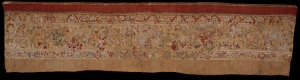
The Victoria and Albert Museum in London houses a cotton temple panel from Nepal, dated to the fifteenth and sixteenth centuries, embroidered with silk, using brick, satin and chain stitch. The embroidery illustrates a mythological scene.
Embroidered Cotton Scarf (India)
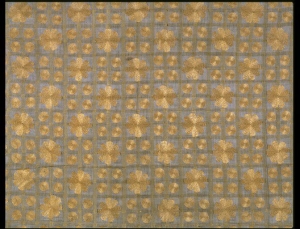
The India Museum in London used to house part of a cotton scarf that was produced in Bengal and acquired in Nepal in c. 1855. It is decorated with a woven checked pattern with tussah silk threads. It is also embroidered in tussah silk with circular and floral motifs. The scarf has been in the Victoria and Albert Museum, London, since 1879. The piece measures 105 x 84 cm.
Jacket (Nepal)
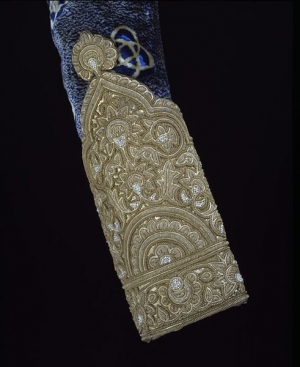
The Victoria and Albert Museum in London houses a remarkable woman's jacket from Nepal, dating to the mid-nineteenth century. It seems inspired by contemporary European/British military uniforms. The velvet garment has large cuffs, epaulettes and the front panels are densely embroidered with seed pearls, sequins and gold thread.
Temple Banner (Nepal)
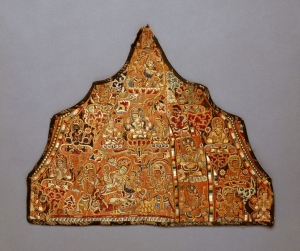
A temple banner from Nepal. dated to the fifteenth century, is housed in the collection of the Victoria and Albert Museum, London. The banner measures 40,5 x 32 cm. The cotton banner is embroidered with silk thread and shows Vishnu and his consort, Lakhshmi, positioned on the eagle, Garuda.