

Hungarian Waistcoat
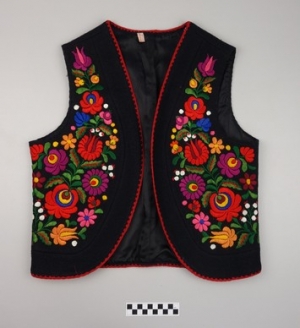
The Textile Research Centre (TRC), Leiden, houses a beautifully embroidered woman's waistcoat that derives from Hungary and dates to the late twentieth century. It measures 47 x 44 cm. It comes from the region of Matyo, and the decoration is characteristic for the area. The waistcoat is made of (factory made) black felt, decorated with rayon thread.
Coptic Monk's Hood (Egypt) at TRC
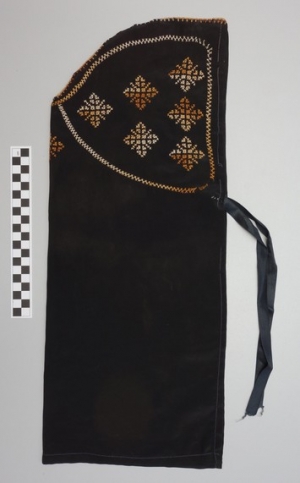
The Textile Research Centre (TRC) in Leiden has a black Coptic monk's hood, called a qalansuwa (TRC 2001.0248). It measures 53 by 23.5 cm and is made of synthetic material and embroidered with brown ombré cotton thread. The embroidery is worked in cross stitch and herringbone stitch.
Beggar's Lace
See torchon lace.
Darning Sampler from The Netherlands, dated 1781.
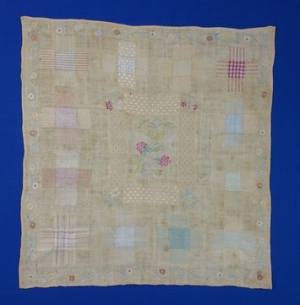
The Textile Research Centre, Leiden, houses a remarkable darning sampler which dates to 1781 and originates from Zeeland, in the southwest of The Netherlands. It is worked in silk thread on a linen ground. It has M R V D B OUD 13 JAAR 1781 (MRVDB aged 13 years 1781) embroidered on it using cross stitch.
Strip of Embroidered Lace

The Rijksmuseum in Amsterdam houses a linen strip of embroidered lace that dates to the late sixteenth century and derives from Italy. The scalopped edge is made of punto in aria needle lace. The strip is 60 cm long.
Lace Collar (c. 1625-1640)
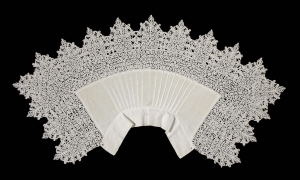
The Rijksmuseum in Amsterdam houses a remarkable lace collar. It dates to about the second quarter of the seventeenth century. It was sewn in The Netherlands, but the lace itself was probably made in Italy. The collar consists of a linen main piece offset with a large panel of lace. The lace attached to the linen main piece is worked in reticella with square shaped motifs. The scalloped edge is worked in punto in aria.
Orange Ribbon (Netherlands, c. 1790)

The Rijksmuseum in Amsterdam houses a ribbon (originally in orange; in Holland called an Oranjelint), on which are embroidered the letters: VIVAT P.W.V. ORANJE ('Long live Prince Willem of Orange'). The sash is made of silk and measures 33.5 x 5 cm.
Dutch Navy Ship's Flag with Embroidery (1865)
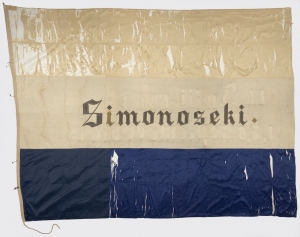
The Rijksmuseum in Amsterdam houses the ship's flag of the Dutch navy steamer 'Medusa', presented to the ship's crew by King Willem III in 1865 in recognition for their role in forcing the Straits of Shimonoseki during the international punitive expedition against the Prince of Nagato (Japan).
Embroidered Cloth (India)
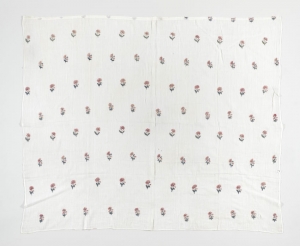
The Rijksmuseum in Amsterdam houses an ivory-coloured piece of cloth made of cotton, powdered with embroidered sprigs of rose-red flowers on a green stem, worked in silk. The cloth originates from India and dates to the late eighteenth century and measures 114 x 137 cm. It may have been part of a dress, or intended to be so, for a woman in early nineteenth century Europe.
Parliamentary Sash
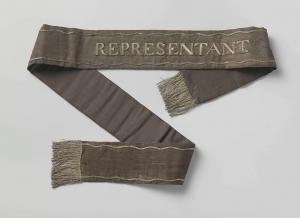
The Rijksmuseum in Amsterdam houses a remarkable shoulder sash with the embroidered text: "Representant". It was worn by Jan Couperus (1755-1833), the 'representative' from the Dutch town of Gouda at the national convention (Nationale Vergadering) in The Hague, which was elected in 1796 by all men in The Netherlands who did not live on social welfare. All 126 representatives wore a sash.