

Asafo Flags from Southern Ghana
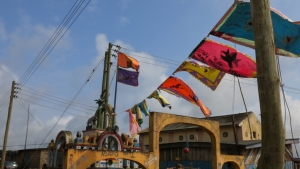
'Art, Honour, and Ridicule: Asafo Flags from Southern Ghana' was the title of an exhibition in the Royal Ontario Museum in Toronto that was opened on 3rd September 2016. It showed flags that served as insignia for the numerous military Asafo companies of the Fante states along the coast of Ghana.
Royal Ontario Museum

The Royal Ontario Museum (ROM) in Toronto, Canada, houses a collection of six million objects that relate to natural history and world cultures. The Textiles and Fashions section holds some 50,000 items that reflect the rich heritage of textile history.
Topkapi Palace Museum
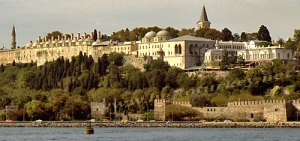
The Topkapi Palace in Istanbul was the centre of Ottoman power from 1465 until 1853, when the sultan moved his court to the Dolmabahçe Palace. In 1924 the Topkapi Palace was made into a museum. It houses a large collection of the sultans' and the princes' clothing, representing the finest examples of Ottoman textile production and needlework.
Valenciennes Lace
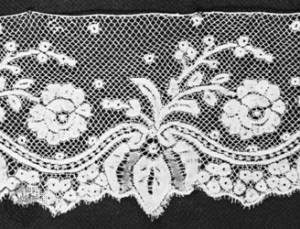
Valenciennes lace is a form of bobbin lace originally from the town of Valenciennes in northwestern France. It was very popular in the eighteenth century. Its production later moved to Belgium and the town of Ypres, and by the nineteenth century it was made by machine.
Cluny Lace
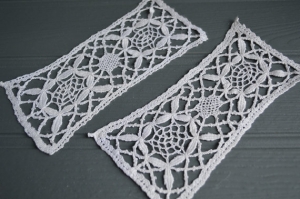
Cluny lace is a nineteenth century form of guipure, bobbin lace. It was worked as a continuous piece. It characteristically has geometric patterns, with radiating, pointed wheat ears. It is said to derive its name from designs that were seen and copied from the Musée de Cluny in Paris. It was made in France, but also in England.
Bedfordshire Lace

Bedfordshire lace, or simply Beds lace, and also known as Bedfordshire Maltese lace, was based on local lace forms traditionally produced in the English Midlands and on the Maltese lace that was developed in the early nineteenth century and on show at the Great Exhibition in London in 1851. Maltese lace, and Bedfordshire lace, are forms of guipure, bobbin lace. The Maltese lace in particular gave the Bedfordshire lace its rounded leave patterns.
Sewing Box (Korea)
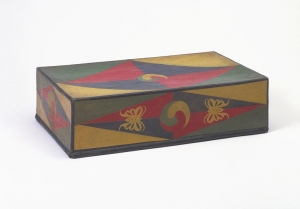
The Victoria and Albert Museum in London houses a late nineteenth or early twentieth century paper and wood sewing box. Such paper boxes were brightly coloured and decorated with butterflies, bats and/or the t'aeguk mark (the two circled commas that denote the harmony of the universe). These boxes were used to keep needlework tools.
Pillow End (Korea)

An embroidered pillow end from Korea, dating to the late nineteenth century, is housed in the Victoria and Albert Museum in London. It is made of wool embroidered with silk and metal threads. These embroidered ends were sewn onto each end of a soft cylindrical pillow, the embroidery providing stiffness and volume.
Rank Badge from Seventeenth Century Korea
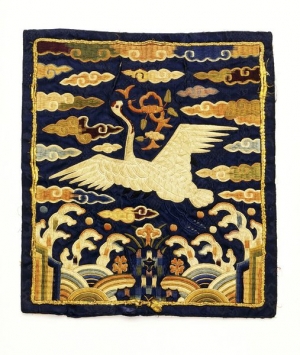
The Victoria and Albert Museum in London houses an embroidered rank badge from seventeenth century Korea. It is made of silk damask worked with silk and gold threads. The embroidery shows a crane holding the Plant of Eternal Youth. The crane is surrounded by stylised waves, rocks and clouds. The badge in the Museum is one of a set of two. It measures 26.7 x 23.8 cm.
Tenjukoku Shucho

The Tenjukoku Shucho ('Embroidery of the Long Life in Heaven') is a set of original fragments plus those of two large draperies, that themselves are thirteenth century reproductions of the original embroidered silk that had the representation of the Buddhist paradise. They are the oldest extant pieces of embroidery known from Japan, apart from some excavated examples.