
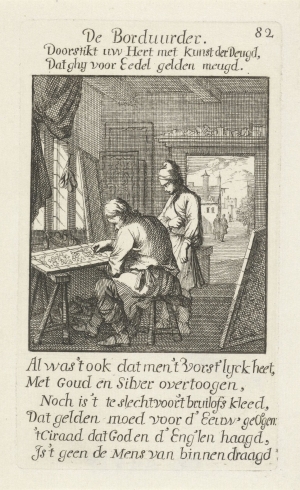
A print (14 x 8.1 cm) now in the collection of the Rijksmuseum, Amsterdam (RP-P-OB-44.538), shows a Borduurder ('embroiderer') hard at work. The print (an engraving), after a copper plate etching, forms part of a collection of one hunded representations of human occupation, called Spiegel van het Menselyk Bedryf, composed in the late seventeenth century by Jan and Caspar Luyken and published in Amsterdam in 1694.

The Melk chasuble is a prime example of opus anglicanum, which was a famous technique practised in England in the thirteenth and fourteenth centuries. The chasuble is now housed in the Museum für angewandte Kunst in Vienna, Austria. It dates to about AD 1300 and measures 116.8 x 487.7 cm. It retains its original bell-shaped form. The arm-holes were cut out later. The colours are somewhat faded.
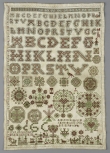
The Rijksmuseum in Amsterdam holds a remarkable sampler (acc. no. BK-NM-9987). It dates to the early eighteenth century and was made in the small town of Hindeloopen in Friesland, in the north of The Netherlands. The ground material is made of linen, while the embroidery is made with silk, using Algerian eyelet, back stitch, cross stitch, double running stitch, hem stitch and staying stitch.
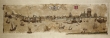
The Rijksmuseum in Amsterdam, the Netherlands, holds a strip of silk cloth embroidered with silk thread and providing a view of the town of Dordrecht. The textile measures 54.5 x 15.5 cm. Included in the embroidery are the coat of arms of Holland and the town of Dordrecht, and the text ANNO 1607. In the bottom right hand corner it says: DAMIS.V.BERNASIE (Damis van Bernasie).
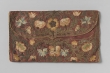
The Rijksmuseum in Amsterdam recently acquired an embroidered letter pouch (acc. no. NG-2011-25) that belonged to the Dutch ambassador to Istanbul (Constantinople), Cornelis Calkoen (1696-1764).
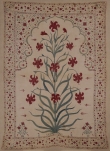
An embroidered Mughal wall hanging or curtain (or prayer mat?), measuring 117 x 81.25 cm, now housed in the Victoria and Albert Museum (acc. no. IS 168-1950), is a beautiful example of Mughal period art from India.

The Victoria and Albert Museum in London houses a beautifully embroidered coat that dates back to the early seventeenth century and originates from Mughal India (acc. no. IS 18-1947).

The Sicilian Tristan quilt, also known as the Tristan and Isolde quilt or the Guicciardini quilt, is perhaps the oldest extant European quilt. It dates to the late fourteenth century, and was made in Sicily. It shows scenes from the story of Tristan and Isolde.
More...
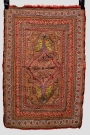
Pateh (Farsi: پته ), or pateh-duzi is a style of Iranian embroidery, in particular from Kerman province in the southeast. It may be linked to local carpet weaving, and many of the embroidered designs recall carpet motifs, such as the toranj (bergamia), sarv (cypress) and the buteh (paisley), but also the sun.
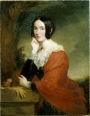
Marianne Margaret Compton, Viscountess Alford (generally known as Lady Marian Alford), was an art patron and author, who was particularly known for her work to support embroidery and the Royal School of Needlework. She was the author of Needlework as Art, an influential book published in 1886.

Needlework as Art is the title of a book by Lady Marianne (Marian) Compton, Viscountess Alford (1817-1888), which was a major influence on late nineteenth century British urban embroidery and how embroidery was perceived. The book was published in 1886 by Sampson Low, Marston, Searle, and Rivington of London.
The Embroidery Show was an exhibition that was held in Museum De Fundatie, Zwolle, The Netherlands, from 28 April to 18 September 2016. It showed some one thousand embroideries that were collected since 2005 at various flea markets and other places by the modern Dutch artist, Rob Scholte.