

The Pigeon wall hanging is an embroidered hanging now in the Victoria and Albert Museum, London. It was designed by John Henry Dearle (1860-1932) for the company of Morris & Co., London. It was probably embroidered from a kit in c. 1898-1900 by Mrs. Battye.
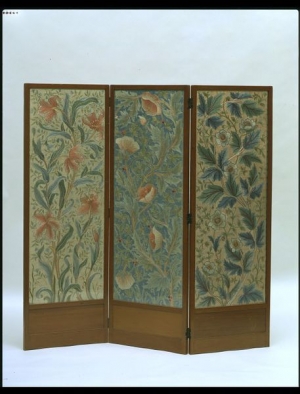
In the collection of the Victoria and Albert Museum (London), there is an embroidered three-panelled screen made by Morris & Co (acc. no. CIRC.848-1956). The panels (from left to right) include the 'Parrot Tulip', 'Large Horned Poppy' and 'Anemone' designs. The designs date from the mid-1880's, but it would appear that the wooden screen frame is later in date.
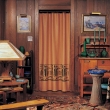
A portière is a curtain hung over a door or doorway to prevent draughts. It was often made of a heavy material and decorated with a woven or embroidered design. Unlike curtains, portières were usually sold and used singularly. According to the Shorter Oxford English Dictionary the use of this French word in English only seems to date from the mid-nineteenth century.

John Henry Dearle (1860-1932) was a British artist and designer who was trained by and worked with the famous Arts and Crafts Movement designer, William Morris (1834-1896). Dearle initially worked as a shop assistant and then became a design apprentice. In 1890 he was appointed as Morris & Co.’s chief designer.

The Museum of Decorative Arts and Design, Oslo (Norway), was founded in 1876 and is one of the oldest official museums in Norway. Locally called the Kunstindustrimuseet, it is regarded as one of the oldest applied art and design museums in Europe. It moved to its current location in 1904. In 2003 the museum became part of the National Museum of Art, Architecture and Design.

'The Needle’s Eye: Contemporary Embroidery' was the name of an exhibition held at the Museum of Decorative Arts and Design, Oslo, about Norwegian and international contemporary embroidery. The exhibition was held from 22 February to 16 May 2015, and organised in collaboration with the Art Museums of Bergen and the National Museum, Oslo.

The Creation tapestry, also known as the Girona tapestry, is an embroidered panel now housed in the Museum of Girona Cathedral, Spain. It dates to the eleventh or twelfth century, and measures, as it survives, 365 by 470 cm. The embroidery depicts scenes that relate to the Christian creation stories, hence its name.

The India Museum was established in 1801, on the basis of the so-called Oriental Repository, in the buildings of East India House along Leadenhall Street, London. Its first curator was Sir Charles Wilkins (1749-1836), founding member of the Asiatic Society. The main attraction of the Museum was the 'Man-Tyger-Organ', which is now on display in the Victoria and Albert Museum.

The Wadsworth Atheneum first opened it doors in 1844 and is the oldest, USA art museum in continuous operation. The Museum’s costume and textiles collection holds approximately 2500 textile objects (including embroideries) and 5000 costumes and accessories. These range in date from the so-called Coptic period (Egypt) to contemporary Western items.

CIETA is an international textile society that was founded in 1954. The abbreviation CIETA stands for Centre International d'Études des Textiles Anciens. It is based at the Museum of Textiles, Lyons, France.
More...

Helen Stevens is an embroidery artist from Bury St Edmunds, England. In 1981 she established her own studio, called 'True Embroideries'. She exhibited her work at many venues, both in England and abroad. She has also been teaching in many ways, including via YouTube films, and she has published a series of books and brochures.

The Museum of Textiles (Musée des Tissus), Lyons, France, is one of the world’s most important museums dedicated to textiles and dress. It is actually half of a double museum, one of which is called the Musée des Arts Décoratifs (Decorative Arts Museum), and the other the Musée des Tissus (Museum of Textiles).

The Njáls Saga tapestry (njálurefill) is a modern embroidery that is based on a traditional Icelandic Viking story called Njáls Saga. It is deliberately being designed and embroidered in the same manner as the Bayeux tapestry. The embroidery is being stitched in Hvolsvöllur in southern Iceland.
Refilsaumur is the Icelandic term for laidwork. The earliest reference to this term dates from the mid-sixteenth century.