
The Irish village of Moynalty lies about six km from the town of Kells and is often said to have been the origin of Moynalty lace.
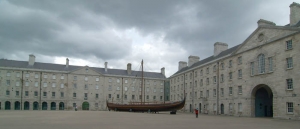
According to the Museum’s website, the decorative arts and history section of the National Museum of Ireland has a large collection of Irish and European lace, including equipment, specimens and objects (garments). The museum is particularly strong on mid-nineteenth to mid-twentieth century Irish lace, having acquired items directly from Irish lace schools, co-operatives and exhibitions.
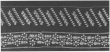
Kells lace was started up and organised by Emma Colston (c. 1796-1877, neé Hubbert) and her husband, Henry Colston (c. 1798-1856). Kells lace was named after the town of Kells in County Meath, Ireland, where Emma Colston's business was established.
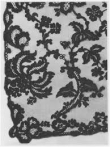
Emma Colston (c. 1796-1877; neé Hubbert) was an Anglo-Irish lace designer and lace runner, who established the company of Kells Lace in 1825. Being the daughter of Henry Hubbert, she and her brother Henry were brought up at Kells (Ireland) and later went to Nottingham. Their father was a lace manufacturer and Henry was trained to take over the family business, while Emma was taught to be a lace runner and a lace designer.
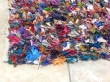
Rag rugs developed in several countries as a means of using up narrow lengths of cloth in order to make cheap floor coverings. Rag rugs come in various forms, including plaited rugs, punched needle rugs and woven rag rugs. Of particular interest to TRC Needles are the punched needle rugs.
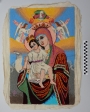
Igolochky is a form of punch needle embroidery from Russia. This type of work has traditionally been used to decorate household furnishings, especially curtains, and in some parts of Russia it can be found on regional dress, such as women’s blouses. This technique has also been used to make religious icons that are normally hung at home.
Igolochka (Иголочка, 'little needle') is the Russian term for a hollow needle (a punch needle) used for making punch needle embroidery (igolochky).
It is cited on various websites that the ancient Egyptians carried out punch needle embroidery using the hollow bones of birds for needles.
More...

Madeira is a family company based in Freiburg (Germany), which produces machine embroidery thread and related items such as felt, needles, scissors, as well as backing materials, etc. The company was founded in Freiburg, Germany, in 1919 by the Messrs. Schmidt. The third generation of the family is now running the business.

David Catá is a Spanish artist who uses his own body as the ground material for embroidery. Catá studied Fine Arts (B.A.) at Vigo University, Pontevedra, and then in 2010 photography at Madrid’s EFTI. He has won or been cited for various art and photography prizes between 2010 and 2013.

Kay’s Practical Embroiderer (patent no. 466,488) is a British patent for a set of metal templates used for creating a novelty form of ‘pile’ embroidery. The patent was taken out on 23rd November 1935. The patent was accepted on 25th May 1937. The patent was taken out by two brothers, Samuel Kauffman and Harris Kay (formerly also known as Kauffman). Samuel Kauffman was described in the patent as being a Russian citizen.
The Ideal Art Needlework Company was a famous early twentieth century firm that sold items for art needlework in the eastern USA.