

The Blackborne collection is a major assemblage of lace, dating from the sixteenth to the early twentieth centuries. It includes some 7000 items, from the remaining stock and study collection of the Victorian-era lace dealers, A. Blackborne and Company of London. This was a father and son business that operated out of London from the 1850's onwards.
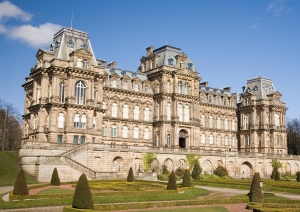
The Bowes Museum (in Barnard Castle, County Durham, England) was opened in 1892 as a museum of decorative arts. It is a purpose built public art gallery that was established by John Bowes (1811-1885) and his wife, Joséphine Chevalier. The collection includes ceramics, furniture, paintings and silver.
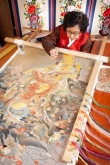
Han Sangsoo (c. 1934) is a Korean master embroiderer who holds the title of jasujang or embroidery artisan. She is regarded as a national treasure (Intangible Cultural Asset no. 80) by the South Korean government.
The Han Sang Soo Embroidery Museum is dedicated to Korean embroidery. It was established in 2006 by Han Sang Soo (c. 1934), a master embroiderer who is regarded as a 'national treasure' (Intangible Cultural Asset no. 80).
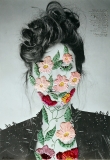
Jose Romussi (1979) is a Chilean born mixed-media artist who uses hand embroidery to embellish photographs. He was brought up in Chile and then went to live in New York (USA). He studied landscape design, but later became known for his prints and collages. He now lives and works in Berlin, Germany.
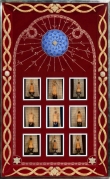
From 20 March to 30 April 2015, there was an exhibition called 'Hidden Within', initiated by Samantha Roddick (1971) at the Michael Hoppen Gallery, London. The exhibition consisted of a series of erotic photographs of women in various poses, which were presented against a backdrop of embroidered velvet and framed using brass mounts.

Mary Katrantzou is a fashion designer born in Athens, Greece. She moved to the USA in 2003 where she attended the Rhode Island School of Design, studying architecture. She later transferred to the Central Saint Martins College of Art and Design. After gaining her BA in 2005, she turned to creating fashion prints. In 2006 she attended the Central Saint Martins Master Fashion Textiles course.
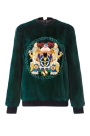
The Greek fashion designer, Mary Katrantzou (b. 1983), is based in London and has produced a number of embroidered garments. During the 2014 fashion season, for example, she designed two embroidered sweatshirts called the “Jumbar G Fur” and the “Topaz Tik Tok". The two sweatshirts are stitched by the embroidery house of Hand & Lock (London).

To commemorate the start of the First World War in 1914, the London-based embroidery firm of Hand & Lock created a specially designed embroidered poppy picture. The use of poppies as a symbol of the Great War (1914-1918) is traditional in Britain and it is normal for people to wear paper poppies for the first week or so of November (the war officially ended on 11th November 1918).

A number of museums and private collections own examples of Queen Victoria’s monogrammed underwear. This is because the monarch was in the habit of saving her undergarments and then giving them to members of her staff. Items given away in this manner include chemises, drawers, nightdresses, as well as stockings.
More...

The Victoria and Albert Museum, London, has a cushion cover in its collection that was designed and worked by the Scottish embroiderer, Jessie Newbery (1864-1948). The cushion cover is regarded by the museum as a characteristic piece of work by Newbery, which is worked in the style of the Glasgow School of Embroidery.
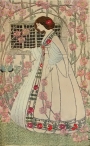
In the late nineteenth century, a new style of embroidery developed at the Glasgow School of Art, which influenced Western embroidery for many decades to come. The new style was developed following changes at the School that took place after 1885 when Francis H. Newbery was appointed as director. He allowed students to develop their own individual talents, rather than forcing them to follow a strict, Classical form of learning.

Jessie Wylie Newbery (1864-1948) was born Jessie Wylie Rowat. She was a Scottish embroiderer and teacher, who studied and worked at the Glasgow School of Art. She was the daughter of William Rowat, a shawl manufacturer from Paisley and political activist, who supported women’s rights. In 1882 she went to Italy and developed a deep interest in textiles and decorative arts.
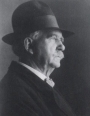
Francis Henry Newbery (1855-1946) was a British designer, painter and educationalist, who worked at the Glasgow School of Art, Scotland. Between 1885 to 1917 he was the headmaster of the School.