

Atelier Stadelmaier: Hemelse Mode rond het Altaar ('Atelier Stadelmaier: Heavenly Fashion around the Altar') was an exhibition about the work of the Atelier Stadelmaier, Nijmegen (the Netherlands) at the Museum Catharijneconvent, Utrecht (the Netherlands), between 10 April and 16 August 2015.

Het Geheim van de Middeleeuwen in Gouddraad en Zijde ('The Secret of the Middle Ages in Gold Thread and Silk') was an exhibition at the Museum Catharijneconvent, Utrecht (the Netherlands), about the use of embroidery on Catholic liturgical garments from the medieval period. The exhibition was held from 10 April to 16 August 2015.

'The World of Hat', Ethnic Museum (sic) is the name of a specialist ethnographical museum that was opened in Riga, Latvia, in 2014. The museum is based on the private headgear collection of the Latvian anthropologist, linguist and traveller, Kirill Babaev. The collection was started in 2002 and now contains over 400 items.

A punch needle is a long needle with a hollow stem and a bevelled point with a large eye. The point of the needle is punched through the ground material, rather than the whole needle being passed through it. The embroidery thread goes down the stem of the needle and is passed through the eye.
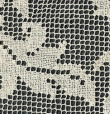
Linen stitch is a term for different types of embroidery stitches that create an end product that resembles a piece of tabby woven cloth, also known as linen weave.

The German artist Hans Holbein the Younger (c. 1497-1543) is known for his fine drawings and paintings, especially for his portraits of North European royalty and notables. Holbein is particularly famous for paintings with highly detailed elements, especially the clothing of his sitters and the embroidery used to decorate the various garments. The embroidery techniques include that of applied jewels and pearls.

The German artist, Hans Holbein the Younger (c.1497-1543), is known for his fine drawings and paintings, especially those of a religious nature, and for his portraits of North European royalty and notables. Holbein was particularly known for paintings with highly detailed elements, especially the clothing of his sitters and the embroidery used to decorate the various garments. The embroidery techniques include yellow work.

The German artist Hans Holbein the Younger (c. 1497-1543) is known for his fine drawings and paintings, especially those of a religious nature, and for his portraits of North European royalty and notables. Holbein is particularly famous for paintings with highly detailed elements, especially the clothing of his sitters and the embroidery used to decorate the various garments. The embroidery techniques include whitework.
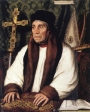
The German artist, Hans Holbein the Younger (c. 1497-1543), is known for his fine drawings and paintings, especially those of a religious nature, and for his portraits of North European royalty and notables. Holbein is particularly famous for paintings with highly detailed elements, especially the clothing of his sitters and the embroidery used to decorate the various garments. The embroidery techniques include gold thread work.
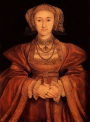
The German artist Hans Holbein the Younger (c. 1497-1543) is known for his fine drawings and paintings, especially those of a religious nature, and for his portraits of North European royalty and notables. Holbein is particularly famous for paintings with highly detailed elements, especially the clothing of his sitters and the embroidery used to decorate the various garments. The embroidery techniques include cutwork.
More...
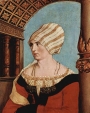
The German artist Hans Holbein the Younger (c. 1497-1543) is known for his fine drawings and paintings, especially his portraits of North European royalty and notables. Holbein is particularly known for paintings with highly detailed elements, especially the clothing of his sitters and for the embroidery used to decorate the various garments. The embroidery techniques painted in these portraits include couching.
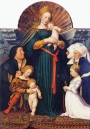
The German artist Hans Holbein the Younger (c. 1497-1543) is known for his fine drawings and paintings, especially those of a religious nature, and for his portraits of North European royalty and notables. Holbein is particularly famous for paintings with highly detailed elements, especially the clothing of his sitters and the embroidery used to decorate the various garments.
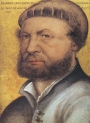
The German artist Hans Holbein the Younger (c. 1497-1543) was the son of Hans Holbein (the Senior; c. 1465-1524), who was also a well-known painter. The younger Holbein grew up in Augsburg and then went to Basel (Switzerland) to study painting. Holbein the Younger is known for his fine drawings and paintings, especially those of a religious nature, and his portraits of North European royalty and notables.

This is a specially designed tailcoat with gold work embroidery worn by the USA artist, Michael Jackson (1958-2009) during his 'Bad' concert tour of 1987-1988. The tailcoat in question is heavily embellished with gold thread embroidery in the form of stylised foliage motifs. The raised areas were created with card templates and then covered with various forms of purl and pearl-purl threads.