
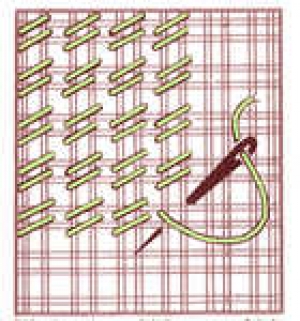
The rep stitch is a counted thread technique for double thread (Penelope) canvas, whereby simple stitches are worked diagonally over the intersection of the canvas threads.

The half cross stitch is exactly what it says: it is half of the cross stitch.
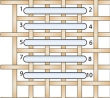
The horizontal satin stitch is a normal satin stitch, but worked along a horizontal line, instead of diagonal or vertical.
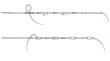
The long running stitch is a variation on a running stitch, the simplest form of embroidery stitch. A running stitch is where the needle ‘runs’ along the ground material. In a ‘normal’ running stitch each stitch created is more or less of equal length and only picks up one or two threads of the ground material between two stitches. A long running stitch is slightly different from the ‘normal’ version.

Straight cross couching is a variation on the basic couching technique, whereby two laid threads are used side by side, and then the couching thread, usually in a contrasting colour, catches down the laid threads using a horizontal cross stitch (as opposed to the ‘normal’ cross stitch that is worked with diagonal lines). GVE

The long chain stitch is a variation on a chain stitch, in which the loops created are much longer than ‘normal'. The length of the loop can vary considerably, depending on how it is used within a design and by which cultural group. This type of stitch is normally used for free-style embroidery. GVE

The long stem stitch is a variation on a stem stitch, in which the ‘body’ of the stitch is considerably longer than the overlap area at the beginning and end of the stitches.
GVE

The interlocking blanket stitch is a variation on a blanket stitch, whereby two rows of blanket stitches are worked that interlock with each other. The two rows are worked separately and may be worked in the same colour or in two, often contrasting colours. The stitches may be worked very close to each other or clearly separate. Mary Thomas calls this stitch a double blanket stitch.
More...
The double fly stitch is a variation on a fly stitch, in which two fly stitches are worked vertically very close to each other, often in different colours.

The twisted fly stitch is a variation on the fly stitch, in which a loop is created by crossing over the two arms of the stitch. The loop is fastened down with a small stitch at the apex of the curve. This form can be found with the stitches close together or detached. This stitch type is used for free-style embroidery and is associated with Saudi Arabian and Yemeni embroidery.
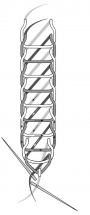
The bi-coloured open chain stitch is a variation of the chain stitch, in which two threads are used of contrasting colours to create a series of chains in alternating colours. This effect can be used for both ‘normal’ (closed) chain stitch and for the open chain stitch, but the open version is more common.

The bi-coloured fly stitch is a variation of the fly stitch, in which two differently coloured threads are used for alternating stitches. It is also known as the checkered fly stitch. GVE