

In medieval Europe, a special type of helmet was made from plates of iron sewn between layers of linen. In the British Museum, London, there is an example of such a helmet (acc. no. 1871,1208.1). The helmet is 21.5 cm high.

In medieval Europe, a special form of armour was being worn, called either a jack or a jack of plate. It was the medieval equivalent of a bullet-proof vest. A jack of plate takes the form of a doublet with a series of small iron plates sewn (quilted) between layers of canvas and sometimes felt. This type of armour may weigh about 7.5 kg.
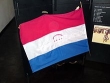
The West African country of Ghana is known for the production of banners and flags decorated with appliqué. These items are often associated with the Fante people, and in particular with the Asafo, the military companies in the western coastal region of the country.
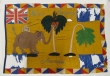
The West African country of Ghana is known for the production of banners and flags decorated with appliqué. These items are often associated with the Fante people, and in particular with the Asafo, military companies who live in the western coastal region of the country.

The Helen Louise Allen Textile collection includes about c. 13,000 textiles, garments and related items, including many embroidered pieces. It is now part of the School of Human Ecology, University of Wisconsin-Madison, Madison (USA). The collection was founded by Helen Louise Allen, a professor of textiles at the University of Wisconsin-Madison. She was particularly known for weaving, and to a lesser extent embroidery.

Helen Louise Allen (1902-1968) was an American professor and collector of (ethnic) textiles from around the world. She was associated with the University of Wisconsin (USA). She is regarded as a pioneer in her field, using historical and anthropological perspectives in the study of textiles.

A tughra is a calligraphic cipher (signature) of an Ottoman sultan. At its height the Ottoman Empire covered a vast area that stretched from the Balkans to Anatolia and the Caspian Sea, and covered much of North Africa and continued along both sides of the Red Sea. The Ottoman court was based at Istanbul, Turkey.

The flat stitch is very similar to the fishbone stitch, but the stitches are worked more horizontally and are more overlapping in the centre. Also known as closed leaf stitch.

The horizontal cross stitch is a variation on a cross stitch, in which the two arms of the stitch are worked vertically/horizontally rather than diagonally. Often the horizontal bar is shorter than the vertical one. This type of stitch can be used for both counted thread work and free-style embroidery.
More...
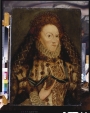
A painting by an unknown artist shows Queen Elizabeth I of England wearing a beautiful gold embroidered dress. The painting dates from between c. 1580-1603. It shows the queen towards the end of her life. She is wearing a richly bejewelled gown, headdress and veil. In her hand she has the badge of the Order of the Garter (also known as 'the Lesser George'), which is suspended from a blue ribbon.

The arrowhead stitch (also sometimes known as an arrowhead) is a diagonal form of stitching, in which a zig-zag effect is created. There are various different ways to create an arrowhead stitch. In the particular example drawn here, the needle comes out at A and goes back into the ground cloth at B. It then resurfaces at C and goes back through the ground cloth at D and so forth.