

The Benaki Museum was established in 1931 by Antonis Benakis in memory of his father, Emmanuel Benakis, a wealthy Greek/Egyptian who created a vast collection of Byzantine, Greek and Islamic objects as well as books, documents and so forth. Since the 1930's the collection has increased considerably.

In 1595, the Flemish artist Anton Vanson (1581-1602) portrayed King James VI of Scotland (who also became King James I of England and Ireland in 1601), when the King was 29 years old (Scottish National Portrait Gallery PG 156). The king, who lived from 1566 to 1625, is depicted in a grey silk doublet, white fur coat and black hat with jewelled band and aigrette. The painting measures 72.90 x 62,30 cm (excl. frame).
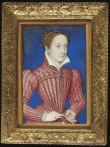
Mary Stuart, Queen of Scots (1542-1587), was portrayed by the French artist François Clouet (1511-1572) when she was about seventeen years old, shortly after her marriage in 1558 to François, heir to the French throne (François II). François died in 1560 and from that moment onwards Mary’s clothing changed and she is generally shown in plain, mourning garments.
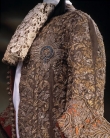
James II (James VII in Scotland) was the son of the British king, Charles I (r: 1625-1649) and a brother of King Charles II (r: 1660-1685). He reigned from 1685-1688. James was married twice, first to Anne Hyde and then to Mary Beatrice d’Este (also known as Mary of Modena; 1658-1718). Queen Mary, wife of King Willem III, was his daughter with his first wife.

The Australian Quaker Narrative Embroidery/Friends in Stitches project (formerly known as the Australian Quaker Tapestry) is an Australian community development and outreach programme. The project was conceived in 2005 when Verley Kelliher, a member of the Religious Society of Friends (Quakers), visited the Quaker Tapestry Centre in Kendal, UK.

A rare sixteenth century Iranian miniature showes a lady working her embroidery. The image comes from a folio of the late fifteenth century Persian work, the Haft Aurang (‘Seven Thrones’), by Nur ad-Din Abd-ar Rahman Jami (d. 1492), from the verso: 'The Flight of the Tortoise'. The manuscript is now in the Freer Gallery of Art, Washington DC, USA.

The Museum of Korean Embroidery (한국자수박물관) is a private museum in Seoul, South Korea. It was founded in 1976 by Heo Dongwha and his wife, Park Young Sook. The museum was opened with an exhibition entitled '500 Years of Traditional Korean Embroidery'.

The U.S. Sanitary Commission was set up in 1861 by women and religious leaders from the northern states of the USA to provide support for Union (northern) soldiers during the USA Civil War (1861-1865). The Commission was authorized by the USA government to manage military hospitals and is credited with reducing the death rate of wounded soldiers by 50%.

Operation Homefront Quilts is a quilting group that was founded in May 2003, when Jessica Porter (Florida, USA) decided to design and stitch a quilt for every USA soldier killed in Iraq. By 2010 Jessica Porter, aided by her mother and thousands of volunteer quilters across the USA, had made and distributed some 2,300 quilts.
More...

Marine Comfort Quilts is a grassroots project in the USA that was originally organized to make and present a quilt to the next-of-kin of every US Marine Corps soldier who died in the war in Iraq. The project began in March 2003 following an attack against a US Marine unit in An Nasiriya, Iraq, which left eighteen marines dead.
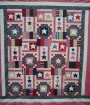
The Home of the Brave Quilt project is a USA grassroots organisation set up to make and present a quilt to the immediate family of every USA military member who has died in the Iraq and Afghanistan wars. The project was founded by Donald Beld of the Citrus Belt Quilters (southern California, USA) and was started in July 2004.
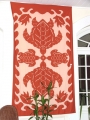
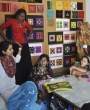
The Kala Raksha Trust is a social development organisation based in Sumrasar Sheikh, in the Kutch region of Gujarat (western India). The Trust’s main aim is to preserve traditional arts, in particular embroidery, by helping artisans to become economically self-sustaining.