

Between AD 872-1072, the Mediterranean island of Sicily was controlled by Muslim rulers. This domination led to a long period of Arab/Muslim influence on local artistic production. It was a period in which many buildings were erected and the capital of Palermo became famous for its academic and religious institutions.

A stomacher is a triangular panel covering a U- or V-shaped gap in a doublet or gown. A stomacher may be boned, part of a corset or cover the corset. Stomachers were normally very ornamental. During the latter half of the fifteenth century, many European urban men and women started to wear stomachers (which were then called a ‘placard’ or a ‘placket’) with open fronted doublets (men) and gowns (women).

There is a passing reference to a small group of embroidered fragments found in a man’s grave in Smela, near Kiev. The excavations were published by Count Alexey Alexandrovich Bobrinskoi (1852-1927) in 1887.
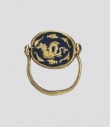
In the nineteenth century, there were various excavations of burial mounds near the Crimean city of Kerch. Textiles were found dating from the fourth - second centuries BC. The textiles include woven, printed, as well as embroidered forms. There are locally made pieces as well as imported examples, notably Chinese silks.
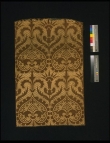
Brocatelle is a type of woven cloth comparable to a brocade, but with a design in high relief. This type of cloth has been made in Europe and elsewhere since the eighteenth century, usually on a Jacquard loom. Brocatelle normally has a firm texture, with a distinctive blistered or puffed appearance. This type of cloth was used for soft furnishings, notably curtains and upholstery.
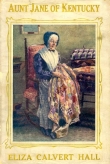
Aunt Jane of Kentucky is a collection of nine short stories written by Eliza Calvert Hall. It was first published in Boston, USA, in 1907. Hall was the pen name of the American writer and suffragist, Eliza ‘Lida’ Calvert Obenchain (1856-1935). Throughout the book, Aunt Jane, an old country woman, uses patchwork and quilting metaphors to explore power relationships between women and men.

Manta is a Spanish word for cloak. Traditional South American mantas are square or rectangular in shape and draped down the back. They are often woven from local cotton, sheep’s wool or alpaca. In some parts of Peru, men wear embroidered mantas during dances to celebrate local Roman Catholic saints’ days.

The use of shells and beads made from bird's eggs, land snails, molluscs and sea shells is probably one of the oldest forms of decorative needlework and still used today. Sixty-five small mollusc shells (Nassarius Kraussianus), perforated with a bone tool, were found in 2004 in Blombos Cave (South Africa). They may have been strung together into necklaces or bracelets and are dated to c. 70,000 to 75,000 years ago.

'Portrait of a Young Girl' is an early seventeenth century painting, now in the British Royal Collection, depicting a young, aristocratic English girl wearing an embroidered gown and a salmon red coat. The artist is unknown. Based on the garments worn by the girl the painting probably dates to c. 1625-1635.
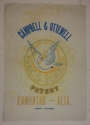
During the First World War (1914-1918), the American Commission For Relief in Belgium (CRB) was set up under the chairmanship of Herbert Hoover (1874-1964; he later became the 31st President of the USA). The aim of the commission was to provide food relief for war-torn Belgium. The CRB was eventually to ship millions of kilos of flour (but also other grains and sugar) to Belgium. These commodities were sent in cotton bags.
More...
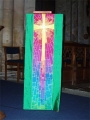
A lectern is a tall, narrow stand with a slanting top. Its primary function is to support books or documents, especially when someone is reading aloud from them. The word lectern derives from the Latin lectus (past participle of legere – 'to read'). In the Christian Church, a lectern is generally used to support a Bible from which the Scriptures are read aloud (a process called the ‘lessons’).

The Wodaabe are a sub-group of the Fula people, many of whom are nomads that live in the southern Sahara. The Wodaabe make use of various embroidered cloths and garments, especially during their annual dances. One of these garments is a rectangle made of sewn, handwoven strips of cotton in dark blue and light blue. This form is normally embroidered along one long edge and one short edge.
The Wodaabe are a sub-group of the Fula people, who are originally nomads that live in the southern Sahara.

The Wodaabe are a sub-group of the Fula people, who are nomads that live in the southern Sahara. They are known for the high jumping dance carried out by the adolescent men during the Gerewol (Guérewol) ceremonies in order to impress potential brides. There are various dances (such as the fijo and the yake) held during the Gerewol and for one of them the men wear a plain leather ‘skirt’ under a long, open sided tunic.