

The gobelin stitch is a type of tent stitch, whereby the thread is worked on canvas over two or more warp/weft threads and the length of the stitch is twice its width. It is sometimes worked as a raised form, which means that it is padded with a thick thread of cord. A padded gobelin stitch either completely conceals the padding or allows part of it to show in order to create and emphasise a geometric pattern.
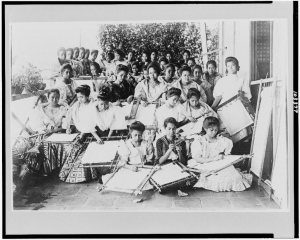
'The embroidery class at Paco school, Manila, Philippines', is a staged photograph. It shows a number of girls who are working on their embroideries that are tensioned on various forms of slate frames. The photograph was taken between 1900 and 1923.
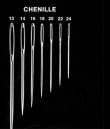
A chenille needle is a large-eyed needle that is very similar to a tapestry needle or a cross stitch needle with respect to its length and diameter. A chenille needle, however, has a very sharp point, rather than a round or blunt form associated with tapestry and cross stitch needles.

The chadari, also often called a burqa, is a form of head and body covering, often decorated with hand or machine embroidery, worn by many women in Afghanistan and Pakistan. The two names, chadari and burqa, have been used for this style of garment for a long time. Basically, burqa is the Pakistani term, while chadari is used in Afghanistan. However, most Westerners use the term burqa for both forms.

A betweens is a short (c. 3-4 cm in length), fine needle with a small, round eye and very sharp point. These needles are often used for tailoring, fine needlework and quilt making. Some manufacturers at the beginning of the twenty-first century also produced a quilting needle, which is slightly shorter and narrower than a betweens.

Baluch embroidery is a form of decorative needlework associated with the Baluchis. The Baluchis form an ethnic group in the extreme southeast of Iran and neighbouring parts of Pakistan (together generally called Baluchistan), and in the extreme southwest of Afghanistan. In addition, Baluch families can be found in India as well as in the Gulf States and Oman.

Emilie Bach was an Austrian artist and author, who in 1873 founded the Imperial and Royal Vocational School of Art Embroidery, Vienna. She wrote various publications on the subject of art needlework, including Muster Stilvoller Handarbeiten für Schule und Haus (1883; 2 vols., Vienna) and Neue Muster im Alten Stil (1887; Vienna; later published in the Th. de Dillmont/DMC series, as New Patterns in Old Styles).

In the Western Christian churches, notably the Catholic and (High) Anglican communities, a number of different cloths are used to dress an altar. The range and appearance of these cloths vary, but in general, white linen cloth is used. Many of these cloths are embroidered in some manner.
More...

The Islamic Republic of Afghanistan is a landlocked country located in Central Asia. Afghanistan is bordered by China, Pakistan, Iran, Turkmenistan, Uzbekistan and Tajikistan. Many ethnic groups from these various countries also live in Afghanistan. The materials, designs and colours used by the Afghan peoples for their embroidery reflect the central and important location of their country.

American term for patchwork made using card or paper templates.
Digital source of illustration (retrieved 29 May 2016)

GVE

Rudesyning is a form of cutwork embroidery from Denmark and produced in the Hedebo tradition. This type of work was regularly used until c. 1900 to make monograms and to decorate towels, knædug (a pole for drying socks over a stove) and the posts attached to either side of the door of a small wall cupboard in small farming communities. This technique is not as open as that of drawn thread work.

Baldyring is a form of whitework embroidery using drawn thread and counted thread techniques. It developed in Denmark in the Hedebo tradition in the nineteenth century. Baldyring finds its inspiration in the fifteenth century reticella needlework. From c. 1835, the technique was used for pillow cases, shifts, shirts, towels, cradle sheets, knædug (a pole for drying socks over a stove) and the door posts of wall cupboards.