
Belgravian embroidery is a late nineteenth century English term to describe a braid decorated with bugle beads.
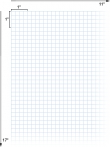
Quadrille paper is a nineteenth century English term for a type of paper that was marked out in small squares, which were filled in in different colours to make embroidery charts. Quadrille paper was especially used for Berlin wool work. It is also known as point paper, or nowadays as quad paper or graph paper.
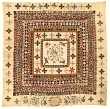
Convict quilts are a form of patchwork quilt made in the nineteenth century by female convicts, often en route to Australia. One of the most famous examples of such an item is the Rajah quilt, which is linked to the British prison reformer Elizabeth Fry. The concept of convict quilts was revived in 2010 when the Victoria and Albert Museum commissioned a quilt from (male) prisoners in HMP Wandsworth.

Rayon is a generic fibre category that includes manufactured fibres composed of regenerated cellulose (mainly from wood pulp). Specific types of rayon include lyocell (also sold as Tencel), modal (often made from beech trees) and viscose. Rayon is characterised by its high absorbency, its draping qualities, its lustre, as well as its ability to be dyed with bright colours. Rayon is often used for clothing and household textiles.
Various chemists were working on adapting cellulose to make fibres in the latter half of the nineteenth century, but it was not until 1894 that the English chemist, Charles Frederick Cross, and his colleagues patented an artificial silk that was commercially viable. They called the new fibre 'viscose'. The first commercial viscose rayon was produced by the British firm of Courtaulds Fibres in 1905. The term 'rayon' was officially accepted in the USA in 1924, while in Europe the term 'viscose' remained in use.
Also known as: artificial silk or wool silk.
Source: TORTORA, Phyllis G. and Ingrid JOHNSON (2014). The Fairchild Books: Dictionary of Textiles, 8th edition, London: Bloomsbury, p. 500.
Digital source of illustration (retrieved 27 June 2016).

GVE
More...

Rozsika Parker (1945-2010) was a British art historian, feminist, psychotherapist and writer. She was particularly interested in challenging the division between fine art and decorative arts, as well as highlighting the minor role that women’s creative work has been allocated within the world of art in general.

The Subversive Stitch is a book by Rozsika Parker, which explores an alternative history of embroidery. In writing this book, the author wanted to show that decorative needlework should not simply be seen as an elegant and innocent pastime for women.

The HMP Wandsworth quilt is a patchwork quilt commissioned by the Victoria and Albert Museum, London, in collaboration with the charity organisation, Fine Cell Work, as part of the Museum's exhibition about British quilting from 1700 until 2010. The exhibition was held in 2010.
Ingrain is a textile term that refers to the fastness of the dye. It means that the dye does not come off easily.