

Parament is a term used by some Christian groups, including Catholic, Orthodox and Protestant communities, to describe decorative ornaments in a church, especially cloth forms such as banners and coverings. The word derives from the Latin paramentum (‘adornment’), a term used to describe the hangings or ornaments of a formal room.

Brussels tape lace is a simple form of Renaissance lace, itself a form of tape lace, and requires the least amount of filling in the gaps between the tape(s).
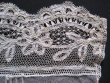
Branscombe lace, or Branscombe tape lace, is a type of Renaissance lace, named after the village of Branscombe in East Devon (England). Branscombe lace started to be made in the mid-nineteenth century using machine made tapes (Honiton braid). By the end of the nineteenth century, Branscombe lace had become very elaborate and the fillings became more detailed.
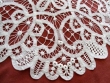
Battenburg tape lace, also (more correctly) named Battenberg tape lace, is named after the German town of Battenberg. It is one of the simplest forms of Renaissance lace, itself a form of tape lace. Battenburg tape lace is a coarser form of Brussels tape lace and uses tapes that are about 8 mm in width. The tape is usually dense and straight sided.

"Tiraz: The Widad Kawar Home for Arab dress" is a private collection of garments, textiles and jewellery, which was built up by Widad Kawar(Amman, Jordan). Tiraz (for short) was opened to the public in 2014. The word tiraz refers to a medieval Arab tradition of embroidering and, later in time, weaving inscriptions into textiles.

Widad Kawar was born in Toelkarem from a Palestinian family and she was raised in Bethlehem. She went to a Quaker school in Ramallah and later studied at the American University of Beirut. She married Kamel Amin Kawar and went to live in Amman, Jordan. The Kawars are a long established family in Jordan, deeply involved in many aspects of the country’s life.
More...

The Italian word lacis is used in different ways: (a) as a general term that is often translated as ‘network', and according to some authors this includes interlaced, knotted or woven forms of decorated net; (b) as a specific form of network that uses a woven net with square meshes. This more specific meaning of the word is used for TRC Needles. It can be described as a form of embroidered lace.
In the USA, filet lace is a general term for two types of embroidered net lace, with a knotted mesh, as in filet 'proper', or with a woven structure.
The French term filet is used in some English language works for a knotted mesh or net, and also for the mesh/net with a darned pattern (also known as filet work or filet lace).