

A cope is a Christian ecclesiastical vestment in the form of a long mantle or cloak, which is open down the front and fastened at the chest with a band or clasp (morse). The earliest European references to copes used by clergy appear to date to the eighth century AD, but it was not until the twelfth century that elaborate copes became a standard part of the Western ecclesiastical dress.

A chestnut bud is a quilt pattern popular in North America, based on the buds from the chestnut tree (genus Castanea). There are a number of variations on this theme, all with the same name.
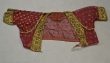
Applied decoration (also called applied work) may include, for decorative needlework, the sewing down of items onto cloth, leather or a similar ground material. These items are normally sewn down in a deliberate and decorative manner and are often combined with decorative stitching. Applied items may include beads, bracteates, cloth, coins, chains, mirrors, seeds, shells, wire, etc.
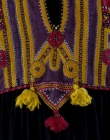
An amulet (Latin: amuletum) is any object that is worn to protect its owner or wearer from danger or harm caused by disease, evil, witchcraft, etc. It is sometimes sewn onto clothing as a form of applied decoration.
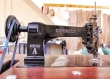
The Cornely machine produces chain stitch embroidery. The history of the Cornely machine mirrors the history of machine embroidery stitching. In the nineteenth century, there were various attempts to produce a simple, commercial machine that could produce a continuous chain stitch.

The so-called Irish machine uses a single, hooked needle that produces a zig-zag stitch with the appearance of a satin stitch. The machine is used to imitate hand made embroidery. Why these machines are called Irish is unknown, but the name is in widespread use.

The early 1860's saw the development of the Schiffli embroidery machine, which produces the machine made equivalent of running stitch, satin stitch and zig-zag stitch. At the beginning of the twenty-first century, it still remains one of the most significant forms of commercial embroidery machines.

Rasheq is a local term to describe a form of Bethlehem couching that has been copied by embroiderers from outside of the Bethlehem region. It was generally regarded as a poorer copy of ‘true’ Bethlehem couching. There is also a style of embroidery produced in Egypt called Rashq, but this is not the same as the Bethlehem form.
More...

Bethlehem couching is a dominant form of Bethlehem embroidery, and was particularly popular in the twentieth century for the panels on women’s dresses and jackets. It is characterised by various forms of cord couching, with thin cords in different colours and often including a metal thread of some kind, which are sewn down traditionally with silk, in sinuous and/or stylised floral patterns.

