

An embroiderer is a man who designs and stitches an embroidery. The female equivalent is an ‘embroideress'. By the end of the twentieth century, the term embroiderer was often used for either a man or a woman. At the same time the word embroiderer also means someone who creates a piece of art (rather than a functional item), using one or more embroidery techniques.
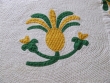
Echo quilting is a style of work, either carried out by hand or machine, in which the stitching follows one or more specific (appliqué) patterns. The quilting lines are running along and parallel to the outline of the patterns, like the ripples or an echo of the shape. This form of work is often used for Hawaiian quilts.

In AD 1613, six pairs of pearl embroidered gloves (perhaps comparable to the pearl-embroidered English glove illustrated here) were sent by the Dutch government to the Ottoman sultan, Ahmed I (r: 1590-1617) in Istanbul. In May of the same year, the Dutch ambassador, Cornelis Haga, oversaw the ceremonial presentation of these gloves, plus a vast array of other precious goods, to the Turkish ruler on behalf of the Staten-Generaal of the Netherlands.

DMC (Dollfus-Mieg et Compagnie) is a French firm that was set up in the mid-eighteenth century by Jean-Henri Dollfus, Jean-Jacques Schmalzer and Samuel Koechlin. The three partners established a company known as Dollfus, based in Mulhouse, France. The company produced textiles with hand printed, Indian-style designs for the European market.
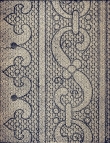
Darned huckaback is a type of darned embroidery on huckaback cloth. This type of embroidery was introduced in Europe in the late seventeenth century and it became very popular in the nineteenth and early twentieth centuries. It was normally worked in floss silk.
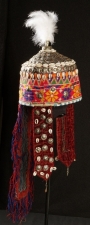
Cowrie (also spelt cowry) is the common name for a marine gastropod of the genus Cypraea, family Cypraeidae. The word cowrie is often used to describe the shell of these snails. The shells are normally egg-shaped, with a flat underside. The term ‘porcelain’ is said to derive from an old Italian term for the cowrie shell (porcellana), on account of its translucent appearance.

Hari Kuyo is a Japanese Buddhist ritual honouring needles. Hari means needle, while kuyo means memorial service. Since ancient times in Japan, people have believed that souls dwell inside all objects, and memorial services are held not only for the deceased, but also for animals and worn out objects such as brushes, combs, dolls, knives, and of course needles.

Misuya needles are made by a Japanese needle shop called Misuya Chubei, in the Matusbara district of Kyoto, Japan, which has been operating since 1819. Kyoto is a city allegedly so obsessed with clothes that many people would live a life of frugality in order to make sure that they can purchase expensive clothes, produced with the best of materials and tools.

An umbrella patchwork was made in the autumn of 2014 from discarded umbrellas during pro-democracy demonstrations in Hong Kong. It was regarded as a site-specific art installation. The demonstrations started when in September 2014 the Standing Committee of the National People’s Congress announced its decision with respect to electoral reform in Hong Kong and how they were going to disallow civil nominations.
More...
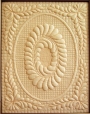
Trapunto is a form of quilting in which a single outline in small running stitches is worked through two layers of relatively fine material. In this technique, the backing is a loosely woven cloth, such as muslin. The stitching is used to create a pattern, which is filled with cotton wadding drawn through the muslin from the back with a steel crochet hook. Each element of the design is padded in this manner.

Shadow quilting is a technique that is comparable to corded quilting. A double outline with small running stitches is worked through two layers of thin, sheer material (such as organdie or a fine silk), rather than a thicker, opaque material in the case of corded quilting.

Kaross is an embroidery initiative founded in 1989 in the Letsitele and Giyani areas of the Limpopo Province, South Africa. Kaross was established by five Shangaan embroiderers and Irma van Rooyen, a visual artist, who was also the creative director and founder. Sitting on local blankets (kaross; hence their name), the ladies started to create works of art reflecting their lives and cultural background.