
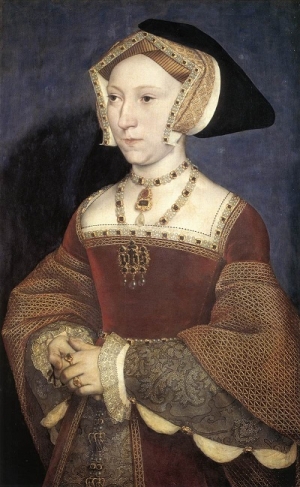
The portrait of Jane Seymour (1508-1537) that was painted by the German artist Hans Holbein the Younger (1497-1543), is of particular interest for its embroidery details. The painting, now in Vienna, dates to about 1536/7. Jane Seymour was the third wife of King Henry VIII of England. The painting was made shortly after her marriage in 1536.

Rug canvas has a meshof strong, cotton threads. This type of canvas is made by twisting two warp threads around each other lengthwise, and locking them around two weft threads at regular intervals. This locking action is required to ensure that the threads cannot be separated and that they make a stable ground material.
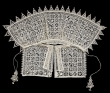
Reticella (Italian, ‘a small net’) is an extreme form of cutwork lace, and thereby classed as a form of embroidered lace. It dates from the late medieval period and involves the large-scale removal of squares of woven ground cloth, usually linen, that are filled in with embroidered patterns. Later reticella used a grid made of thread rather than a cloth ground.
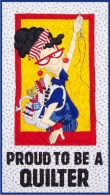
Quilter is a term used in English-language quilting groups to refer to either of two people making quilts. These two are: 1. the person who designs and/or makes a quilt top, or 2. the person who stitches or ties the layers of a quilt together. This may or may not be the same person who designs and/or stitches the quilt top.
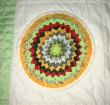
Pine burr is a three-dimensional quilt style, also known as pine cone, in which overlapping triangular swatches are placed in a circular pattern, starting from the centre. This style was very popular with African-American quilt makers in the southern USA throughout the twentieth century.
There is a reference to what is generally translated as 'Phrygian embroidery' in Pliny the Elder’s (AD 23-79) Naturalis Historia, which was completed in c. AD 77.

A partlet is a type of upper body garment worn in western Europe, during the sixteenth and early seventeenth centuries. It was more commonly used by women than men. The partlet was used to fill in the low, square neckline of a gown. Middle class and informal aristocratic dress always kept the bosom and neck covered, with either a smock or partlet.

Nishi kogin is a form of kogin zashi (a type of pattern darning) from Japan. Kogin literally means 'small cloth' and zashi means 'stitches'. It is one of the sashiko forms, and was developed by the farmers of the Tsugaru region in the northern part of Honshu Island, Japan, and in particular from west of the Iwaki River.
More...
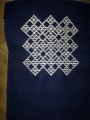
Kogin zashi (or simply kogin) clothing from Japan is a regional style characterised by its decoration with a form of pattern darning. It is regarded as a form of sashiko. It derives from the Aomori Prefecture, in the northern part of Honshu Island, Japan.

Mishima kogin in Japan is a form of kogin zashi and is characterised by pattern darning. Kogin literally means 'small cloth' and zashi means 'stitches'. Kogin is one of the sashiko forms, which were developed by the farmers of the Tsugaru region in the northern part of Honshu Island, Japan, and particular from the delta of the Iwaki river.
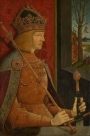
Emperor Maximilian I (1459-1519) was portrayed by the German painter, Bernhard Strigel (1460-1528). The German emperor is shown with his imperial regalia, including crown, staff and sword. The painting dates to after 1507 and measures 85 x 52.5 cm. Over his shoulders the emperor has a red mantle decorated along the edges and back with a broad, turquoise band of applied jewels and pearls.

The Mantle of Roger II, the Norman king of Sicily (r. 1130-1154), is made of red silk and is embroidered with gold and silk thread as well as with applied semi-precious and glass jewels. It formed part of the imperial regalia of the Holy Roman Empire. The mantle dates from c. 1134. The garment was made in Palermo, Sicily, probably by Arab craftsmen.