
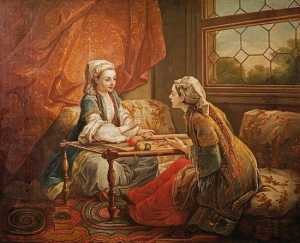
'Madame de Pompadour Embroidering' is a painting by the French artist Carle or Charles-André van Loo (1705-1765). It shows Madame de Pompadour behind an Ottoman-Turkish embroidery frame. The painting dates to AD 1750-1755. Jeanne-Antoinette Poisson (1721-1764), better known as Madame de Pompadour, was the official mistress of King Louis XV of France (r: 1715-1774).

The Laughing Cavalier (as it is popularly known) is a painting of an unknown man, by the Dutch painter Frans Hals (c. 1582-1666). It dates to 1624 and measures 83 x 67.3 cm. The sitter's doublet (type of jacket) is embroidered with red, yellow and white designs, such as arrows, caducei, cornucopias, knots and flames.
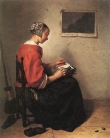
The Lacemaker is a painting by the Dutch artist, Caspar (Gaspar) Netscher (1639-1684), of a young woman making bobbin lace. The painting (33 x 27 cm), dates to AD 1662. The woman is wearing an under or indoor cap embroidered in black on a white ground (blackwork). The design is of interconnecting foliage motifs characteristic of the period. This type of cap later became the hul form worn in the western parts of the Netherlands.
Kanakara is a Greek term from the island of Karpathos and refers to the first born girl in a family. The male equivalent is a kanakaris. Until the mid-twentieth century, the island of Karpathos in the southeastern part of the Aegean Sea had a local inheritance tradition and law that meant that first born sons and daughters were treated differently from their younger siblings.
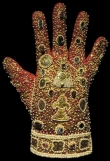
The Imperial Gloves (Kaiserliche Schatzkammer, Vienna) form part of the imperial regalia of the (German) Holy Roman Empire. The gloves date to before AD 1220. The gloves are believed to have been made in Sicily. They are made of red silk decorated with applied jewels and enamelled plaques. The front and back of the gloves are decorated with couched goldwork using a plate thread.

Higashi kogin is a form of kogin zashi (itself a form of pattern darning) from Japan. Kogin literally means 'small cloth' and zashi means 'stitches'. It is one of the sashiko forms, and was developed by the farmers of the Tsugaru region in the northern part of Honshu Island, and in particular from east of the Iwaki river.

A hassock is a small, padded rectangular wooden box with no legs, which some Christian groups use in church to rest their knees when kneeling, usually to pray. The top of a hassock may be covered with a canvas work embroidery using a variety of hardwearing stitches, such as cross stitch, trammed tent stitch or rice stitch.

Frogging is a late twentieth century English (USA) language term referring to the unpicking of knitting or an embroidered motif, following a mistake or change in a design.

The German artist Bernhard Strigel (1460-1528) painted a group portrait of the German Emperor Maximilian I (1459-1519) and his family. Of particular interest is the man in the centre with the black cap with large blue jewels. He is wearing a chemise style undergarment without front opening.
More...

In the sixteenth century, picture books started to appear in Italy and other European countries depicting often surreal situations with Latin mottos. With this development, people commenced to adopt for themselves or their families an individual image from these illustrations with a suitable Latin motto.
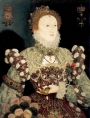
Queen Elizabeth I of England (r: 1558-1603) was portrayed by the English painter, Nicholas Hilliard (1547-1619). The painting dates to about 1574. The queen is depicted wearing a plum red gown decorated with applied jewels, including pearls and emeralds.

For hundreds of years, mainland Chinese ateliers have been making hand worked embroidery for international markets. These forms are often worked in Chinese or Chinese related styles. In the nineteenth and twentieth centuries, many 'Chinese' pieces sold in Indonesia, for example, were intended for Dutch customers. Chinese shawls were also embroidered for the Moroccan, Palestinian and Spanish markets.
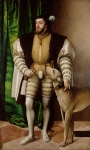
The German artist, Jakob Seisenegger (1505-1567), painted a portrait of Charles V (1500-1559), Emperor of Germany and King of Spain (205 x 123 cm). The painting dates to c. 1532. The Emperor is depicted wearing an elaborate coat and hose in a richly woven, off-white cloth, and is acccompanied by his dog. The portrait was used by Titian in Bologna for his own painting of Charles V, now in the Prado, Madrid.