

Tent stitch is an umbrella term for several different, but related free style and canvas embroidery stitches. A tent stitch is a small, diagonal stitch that crosses the intersection between the horizontal and vertical threads of the ground material. The term ‘tent’ derives from the French tenter, meaning ‘to stretch.’

Tatting is a knotting technique used to make a form of lace with a series of knots and loops (picots or purls). It is made using a small shuttle. In Western Europe this technique seems to date to the late eighteenth century and may be a development of knotting. It became popular in the late nineteenth century.
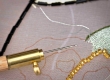
A tambour hook is a very fine hook housed in a wooden or metal handle, which is used to create a chain stitch while working tambour embroidery or tambour lace. In India, tambour embroidery is called ari embroidery and is carried out with an ari hook, which is comparable, but not identical to a tambour hook. The technique of creating the chain stitch is the same.
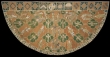
The Syon Cope is a Christian liturgical vestment associated with Syon Abbey, Middlesex (England). It was made between 1300 and 1320. Copes are semi-circular outer garments, usually highly decorative, worn by priests on special occasions. The Syon Cope was made from a much larger chasuble.

Suzani is the general term for a type of large, embroidered textile from mainly Uzbek communities in Central Asia, and found in Afghanistan, Kazakhstan, Kyrghyzstan, Tajikistan, Turkmenistan and Uzbekistan. The term derives from the Persian word suzan or ‘needle’ and suzanduzi for 'needlework'. The oldest surviving suzanis date from the late eighteenth century, but it is likely that their production and use date back to much earlier times.
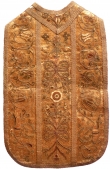
The Treasury of the St Vitus Cathedral in Prague, Czech Republic, holds a set of straw-made and embroidered religious vestments. The garments include a chasuble, maniple and stole (C.k. 114, cat. no. 84). They are all made out of decoratively woven straw. In addition, the garments are embellished with stylised floral motifs outlined in straw (2ply, Z-spun), which have been couched down using what appears to be a linen thread.

Straw is the dried stalk of a cereal, as for instance barley, oats or wheat. Straw is sometimes used to create a woven cloth or as material for embroidery.

A stitching awl, also known as a sewing awl, is a tool consisting of a thin, tapered metal shaft coming to a sharp point, either straight or slightly bent. The shaft is normally fastened to a wooden handle. It has an eye at the sharp pointed end, through which a thread is drawn.

Stained glass patchwork is a twentieth century form of patchwork, whereby areas of coloured cloth are separated by monochrome bands (such as in black), in imitation of stained glass windows.

Charles Germain de Saint Aubin (1721-1786) was a draughtsman and embroidery designer to King Louis XV (1710-1774) of France. His parents were Germain de Saint Aubin and Anne Boissay, both of whom were professional embroiderers. His paternal grandfather had moved from the countryside to Paris and had set up an embroidery atelier.
More...

St. Luke (Luke the Evangelist) is one of the four evangelists or authors of the canonical four gospels of Jesus Christ (The New Testament). He lived in the first century AD and originated from the city of Antioch, Syria. He became the patron saint of artists, embroiderers, painters, tapestry makers, weavers, among other professions. According to the Roman Catholic calendar, his feast day is 18th October.

Spanish work is a sixteenth century English term for blackwork embroidery, especially in the double running stitch (Holbein) form. The technique of blackwork embroidery was reputedly brough to England by Catherine of Aragon, the first wife of Henry VIII.

On 24th August 2006, the USA Postal Service issued a set of commemorative postage stamps with the theme of the Gee's Bend quilts. The 39c stamps depict ten designs that date from c. 1940 until 2001. The quilts were made by African-American women in Gee’s Bend, Alabama. The women from this town are well-known for the production of colourful and bold quilts, which were traditionally made of old garments.