

A double running stitch is a technique used for counted thread embroidery, in particular in blackwork embroidery and Assisi embroidery in Europe. The double running stitch consists of a simple running stitch worked in two journeys over the same line. The characteristic feature of this stitch is that it is identical on the front and the back of the ground material.
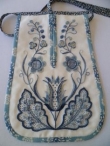
Deerfield embroidery is a form of blue-on-white work (free style) associated with the town of Deerfield in western Massachusetts, USA. It was promoted by Margaret Whiting and Ellen Miller, who in 1896 set up the Deerfield Society of Blue and White Needlework for the revival and production of monochrome, usually blue embroidery based on eighteenth century local examples of crewel embroidery (see Delft embroidery).
Damask stitch is a nineteenth century English term given to satin stitch when it is worked upon linen for household purposes.

Judy Chicago (USA, 1939) is an American artist whose large-scale projects incorporate embroidered elements. Chicago is best known for The Dinner Party, a collaborative installation on permanent display in the Brooklyn Museum, New York. It travelled throughout the USA from 1974 to 1979.

Cross stitch embroidery is a widespread form of counted thread embroidery, in which X-shaped stitches are used to create a design or pattern. Cross stitch embroidery should not be confused with canvas embroidery. The two types of work are comparable, but the first is generally worked on a cloth ground (rather than canvas), such as a linen or cotton even weave material, and the design may cover all or part of the ground material.


Congress canvas is a form of mono-canvas made from cotton, with a mesh count of 24 per inch. At the beginning of the twenty-first century a major producer of this type of canvas was the German firm of Zweigart und Sawitzki.

Celtic cross-stitch embroidery is a style of counted thread embroidery using cross stitches to create Celtic art patterns. It was popular in the late twentieth and early twenty-first centuries. The designs include intricate geometric patterns, interlacing forms, knotwork, spirals, as well as stylised figurative and zoomorphic patterns, all worked in a range of rich colours.
More...
Bolting is a nineteenth century form of canvas, so named because it was originally used for bolting or sieving meal and flour.

From the thirteenth to the seventeenth centuries, Bohemia was known for the production of applied pearl embroidery.

Blackwork is a form of counted thread embroidery that uses a black thread (usually silk or cotton) on a white cloth background. Blackwork is usually carried out in a double running stitch (Holbein stitch). The patterns produced tend to be geometric or stylised figurative and plant forms. Blackwork was very popular in Europe during the sixteenth century and has been revived at regular intervals since then.
Broderer is an English term dating back to the Middle Ages. It refers to a worker (usually male) in hand embroidery. The term broderer is derived from the French word broderie or ‘embroidery.’