
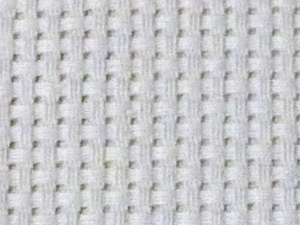
Binca is an English (UK) trade name given to a form of embroidery canvas that is woven in groups of threads, rather than individual threads. It is consequently sometimes classed as a mock-leno weave. It is the same as aida, but slightly coarser, with about 2-3 meshes per cm. The name binca appears in the late 1960's. It is sometimes used in English publications as a synonym for aida or bincanette.

Elizabeth Talbot, Countess of Shrewsbury, is more generally known as Bess of Hardwick. She is famous for her textiles and needlework, some of which she made herself. Her textiles include embroidered bed hangings, bedcovers, chair upholsteries, pillow covers, table covers and wall hangings.
Making artificial flowers in Berlin wool was a fashionable pursuit in mid-nineteenth century Europe and North America.
Beeswax is a natural wax produced by honey bees of the genus Apis. Beeswax is used to protect and strengthen a sewing thread. Beeswax is especially used for goldwork and other forms of decorative needlework.
Bazaar article is a late nineteenth century term used to cover a wide range of small items made for sale in English bazaars, to raise funds for charity.
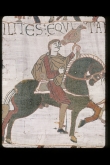
The Bayeux Tapestry is a commemorative embroidery that depicts the events leading up to the Norman conquest of England in 1066 by William the Conqueror (1028-1087). The tapestry is now exhibited at the Musée de la Tapisserie de Bayeux, France. The earliest known written reference is in a 1476 inventory of Bayeux Cathedral, France.

An album quilt is a type of commemorative quilt, which is still popular among American quilters. It is also called an autograph quilt. This type of what is in fact a patchwork quilt started to appear around the 1840's in Baltimore, Maryland (USA), among Methodist women, who travelled from one religious service to another, sharing designs at the same time.

Azemmour embroidery originated from a small town along the Atlantic coast of Morocco, about 75 km southwest of Casablanca. Azemmour is an ancient port with connections to many Mediterranean countries. It was known for its counted thread work with a negative design.

An awl is a small tool with a slender, tapering, sharp-pointed blade, with which holes are pierced into thick materials, such as leather. It is sometimes (incorrectly) called a bodkin.
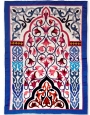
Appliqué is a needlework technique, whereby a piece of cloth or other material is laid on top of another, normally larger piece and the two are stitched together, often to create a decorative effect. Such a combined piece of cloth may in its turn be stitched on top of another.
More...

Antique canvas is a late twentieth century term given to brown or beige coloured canvas.

The Aids Memorial Quilt is a long-term project to make a vast commemorative quilt for Americans who died of HIV/aids. The Project was launched in 1987 by gay rights activists in San Francisco, California, when the disease’s stigma resulted in some American funeral parlours refusing to accept the bodies of aids victims.
Also written acu pictura. This is a medieval Latin term meaning ‘painting with a needle,’ referring to embroidery.