

The chequered chain band is an embroidery technique that is worked downwards and with two needles, often with threads with different colours. This composite stitch is often used to create a wide border.
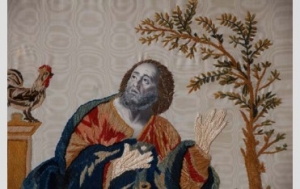
Arrasene, or Arasene embroidery, is a form of chenille embroidery, which was popular in the late nineteenth century and used for curtain borders, mantelpiece borders or screens, at places where the fine Arrasene material was unlikely to get damaged. Arrasene embroidery is known to have been worked in tent stitch on canvas, or in stem stitch or crewel stitch on velvet or serge, or with couching as braid work.

A fir stitch is a canvas embroidery technique whereby a vertical straight stitch is worked over six horizontal threads. The vertical stitch is then flanked along an imaginary line taken from the bottom of the vertical stitch by five slanting stitches on both sides. The stitch is completed with another straight vertical stitch over four threads to combine the flanking stitches and to link up with the first vertical stitch above.
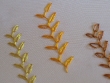
The feathered chain stitch is a variation of the chain stitch. It is worked from top to bottom, and is created from side to side in a zig-zag manner.

A chain ring is a length of crochet chain that is made into a ring by linking the ends of the chain using a slip stitch.


A portrait of Queen Elizabeth I, painted around 1599 in the studio of the English goldsmith and painter, Nicholas Hilliard, shows the British queen in the last years of her life. The portrait was perhaps commissioned by Bess of Hardwick, and is housed in Hardwick Hall, Derbyshire. The painting measures 223.5 x 169 cm.

The National Portrait Gallery in London houses a portrait (91.4 x 75 cm) of Sir Walter Raleigh (c. 1554-1618), dated to 1588 and painted by an unknown artist. It shows the famous English sailor and explorer, and also author, courtier and poet, who made various voyages to Middle and South America. He was instrumental in the British colonisation of North America, and was dedicated to the seach for the famous El Dorado.

The (diagonal) Cashmere stitch is a technique that includes groups of three or four straight stitches of varying lengths, worked diagonally and in blocks. Generally the first block starts in the top left or right-hand corner and a row of blocks is continued to the opposite bottom corner. The next row starts at the bottom, next to the first row.

Shahtush is a type of fibre, and the name of the fabric woven from it, that derives from the down hair of the Tibetan antelope (chiru; Pantholops hodgsonii). This animal is now nearly extinct, and hence the collection and processing of shahtush is forbidden in many countries, although the wool's use is known to continue in isolated parts of Kashmir and neighbouring lands.
More...

Pashmina is an ultra-fine form of cashmere, and derives from the extreme northwest of the Indian subcontinent. The name is Persian in orgin (pashm, 'wool')).

Cashmere is a very fine fibre from the undercoat of the long-haired Kashmir goat (capra hirgus laniger, but currently regarded as a sub-species of the capra aegagrus hircus). It is much softer than normal wool, and it also isolates much better.

Camel hair is shed by Bactrian (two-humped) camels in the spring. It is soft and very light. It is often used for weaving coats and other over garments, and sometimes used together with (sheep) wool.

A cable stitch is used for smocking and includes two rows of running stitches, whereby the stitches in one row cover the gaps between the stitches in the second row.