
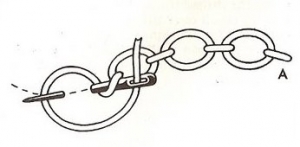
The cable chain stitch is a technique that creates a neat embroidered line of chain. It is formed by a chain stitch followed by another separate chain stitch, after looping the thread around the tip of the needle, creating the 'cable' that combines the stitches.

The butterfly chain stitch is a composite stitch that includes three vertical straight stitches brought together in the middle by a horizontal twisted chain stitch (sometimes worked in a different colour).

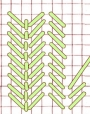
The broad stem stitch is a composite stitch that includes two vertical rows of diagonal straight stitches arranged opposite each other creating a V-shape. Between the two rows a row of backstitches is worked, often in a different colour.
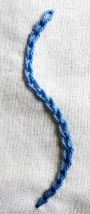
The reverse chain stitch is worked in the opposite way to the ('normal') chain stitch. If the chain stitch is worked from the top to the bottom, the reverse chain stitch is worked from the bottom to the top. The reverse chain stitch is also known as the broad chain stitch.
More...

The Gordion knot stitch is a form of twisted chain stitch, which is worked between two imaginary horizontal lines, whereby the first twisted stitch is worked from the bottom to the top line, and the second stitch, to the left, from the top to the bottom line.

Boutis quilts originate from along the southern coast of France, around Marseille. They are characterised by the stuffing (boutis in Provençal) being sandwiched between the two layers of the quilt in specific parts of the design. Boutis are regarded as a form of Provençal quilting, and they seem to have been made since the nineteenth century. The term boutis is nowadays often used for all forms of Provençal stuffed quilting.

Bouclé is the name for a yarn of varying thickness, which creates an uneven effect in the fabric. The yarn is created by plying together two or more threads of different diameters and twist. This creates a yarn that has small loops and a varying thickness. The name is also used for the resulting fabric itself. See also the bouclé stitch.