

The backstitched chain stitch is a composite stitch, which combines a chain stitch with a back stitch. A chain stitch is worked along one line, which is subsequently worked backwards with a back stitch, sometimes in a different colour, thus creating a firm, textured line.

An air-erasable marker is used to draw lines and/or motifs on a piece of fabric, for further sewing or embroidery. The marked lines or motifs disappear by themselves within fourteen days or so.

An Afghan hook is used for so-called Afghan, or Tunisian crochet work. It looks like a cross between a 'real' crochet hook and a knitting needle.
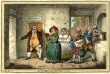
The British Museum in London houses a hand-coloured satirical etching, called 'An Old Maid on a Journey', which was made by the cartoonist, James Gillray, and which was based on the work of the amateur draughtsman, Brownlow North (1778-1829), son of Brownlow North, the Bishop of Winchester. The print measures 25.5 x 38.3 cm and was published by Hannah Humphrey (c. 1745-1818; No. 27, St James's Street, London).
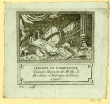
The British Museum in London houses a trade card for the French firm of Chomel & Co., dating to the period 1760-1818. The text reads: "Chomel et Compagnie, tiennent magazin de modes, broderies et fabrique des fleurs à Paris." The print itself says: "A l'union des arts, Rue Neuve St. Eustache."

The British Museum in London houses a woman's apron from among the Sarakatsani (originally a nomadic group) in northern Greece. Locally called a podia, this example is 36 cm long and made of wool with cross stitch, cotton-thread embroidery, rik-rak and metal thread decoration. The apron is dated to sometime between 1925 and 1950.

The British Museum in London houses an embroidered but unfinished border for a sleeveless, ankle-length woman's dress (foundi) from Attica, Greece. It dates to the period 1925-1950 and is made of cotton with silk thread embroidery. The grey markings for the embroidery are still visible. The motif is traditional to the region, and called a pomegranate, an upside-down omega or a vase with flowers.

The British Museum in London houses a floor cover that was acquired in Afghanistan in the mid-nineteenth century. It measures 635 x 93.5 cm and is made of cotton with silk thread embroidery worked in chain stitch with an ari hook. The floral motifs include the buteh or paisley motif, well-known from Kashmir weaves and embroideries.
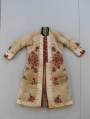
The British Museum in London houses a man's coat from among the former German population in Transylvania, now in Romania. The coat dates to the period 1880-1920. It measures 125 x 59 cm. The coat is made of sheepskin, and decorated with cut leather appliqué and embroidery.
More...

The British Museum in London houses an embroidered woman's blouse from Russia, which dates to the period 1895-1910. It measures 84 x 170 cm. Made of cotton, the blouse is decorated with simple embroidery worked with red silk threads, using cross stitch.
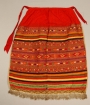
The collection of the British Museum in London includes a woman's apron from Russia, which dates to the period 1895-1910. It measures 85 x 68 cm. For the greater part made of wool, the apron is decorated with embroidery in coloured threads, sequins and metal thread (passing) plaited into narrow ribbons. The narrow top section is made of cotton.
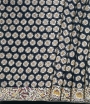
The Victoria and Albert Museum in London houses a sari with a silk ground material in black. The sari (115 x 546 cm) is decorated with silk thread embroidery in white, magenta and yellow, using satin stitch and stem stitch.

The Victoria and Albert Museum in London holds a woman's jacket (71 cm from collar to hem), made of silk, and embroidered with very brightly coloured silk threads using satin stitch. The jacket was made in China, obviously for a Western market.