

Martha Ann Erskine Ricks (d. 1901) was born into slavery in the USA, around 1817. Her father worked to buy his, his wife’s and their seven children’s freedom. When Martha was 13 the family sailed to Liberia. Within a year only Martha and her two brothers remained alive. Martha married and helped manage a farm where she grew coffee, cacao, sugar cane and ginger.
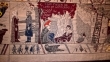
Some thirty volunteers have completed a massive embroidered tapestry of some 90 metres long to commemorate the Battle of Winterfell, the Battle at King's Landing and the Red Wediing. All are episodes from the hitseries Game of Thrones.
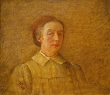
Phoebe Anna Traquair was born in Ireland, and achieved wide-spread recognition for her role in the development of the Arts and Crafts Movement in Scotland. She was working within the context of the Celtic Revival and the pre-Raphaelites.
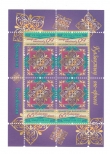
The collection of the Textile Research Centre in Leiden, the Netherlands, houses a series of four postage stamps from Kazakhstan with depictions of local geometric embroidery motifs (TRC 2018.2837). These motifs are found on cloth and felt ground materials.
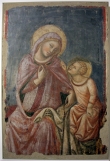
The Madonna del Ricamo (Our Lady of Embroidery) is the name of a fresco allegedly by the Italian medieval artist, Vitale da Bologna (c. 1309-1360). The fresco is now housed in the Museo della Storia di Bologna. It dates to the period between 1330 and 1340. The fresco measures 118 x 79 cm.

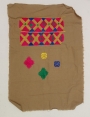
This item is housed at the Textile Research Centre in Leiden, the Netherlands. It is an embroidered sample, measuring 38 x 24 cm, from among the Miao ethnic minority in southern China. The motifs are hand embroidered with darning stitch and satin stitch. The sample dates to the late twentieth century.

The Textile Research Centre, Leiden, The Netherlands, has an embroidered panel (32 x 10 cm) intended for a Miao woman's jacket. It is half finished, and so it is easy to see the paper template that forms the basis of the design.

The Textile Research Centre, Leiden, the Netherlands, houses a paper template (30 x 32 cm) for embroidery, from among the Miao ethnic minority in southern China. The template dates to the early twenty-first century.

The collection of the Textile Research Centre in Leiden, the Netherlands, includes a hand embroidered, woollen jacket from among the Pashtun tribe of the Mangal, who live along the border between Afghanistan and Pakistan (TRC 2005.0001). The coat is decorated with stylised flowers and geometric motifs, on the front and back.
The ground material of the coat is a coarsely woven cloth. The embroidery thread is dark red, made of wool. The stitches used are chain stitch and straight stitch .
See Gillian Vogelsng and Willem Vogelsang, Encyclopedia of Embroidery from Central Asia, the Iranian Plateau and the Indian Subcontinent. 2021. London: Bloomsbury Publishers, pp. 218-219.
TRC online catalogue (retrieved 17 May 2021).
WV
More...

The Textile Research Centre in Leiden, the Netherlands, houses a hand embroidered, cotton jumlo from northern Pakistan.

The Textile Research Centre in Leiden, the Netherlands, holds an embroidered panel (82 x 44 cm) that most likely derives from, or from near the town of Mansehra, in the Hazara Division, of Khyber Pakhtunkhwa Province, in northern Pakistan. The cotton and silk panel dates to the early twentieth century.
The Swat Valley Guild is an organisation working in the Swat Valley north of Peshawar, in northern Pakistan. It supports artisans to retain their craft and help develop their access to the global market.

The Textile Research Centre in Leiden, the Netherlands, holds an embroidered panel (TRC 2018.2744) that originates from the north of Pakistan, in the Hazara Division, which lies east of the Indus river, and which forms part of the Khyber-Pakhtunkhwa Province (TRC 2018.2744). The capital of the Hazara Division is Abbottabad.