

The Textile Research Centre in Leiden, the Netherlands, houses a woman's dress from among the Khattaks, a Pashtun tribe living southeast of Peshawar, west of the Indus river. (TRC 2018.2738). The dress is made from various pieces of black and dark-grey material.
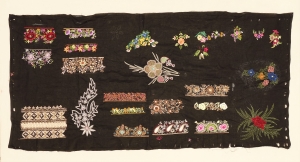
The Textile Research Centre in Leiden, the Netherlands, houses a sampler showing a variety of local embroidery techniques, including embroidery itself, beading, cut work, gota work, knotting, and metal thread embroidery.
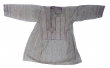
The Textile Research Centre in Leiden has an embroidered shirt that is linked to the Pashai community in Afghanistan (TRC 2018.2581) The Pashai live northeast of the Afghan capital, Kabul, and speak a Dardic (Indic) language, different from the dominant Iranian and Turkic languages of the country.
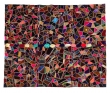
From 20th August until 18th October 2018, the Textile Research Centre in Leiden set up an exhibition of American quilts donated to the TRC by the American collector and quilt specialist, Sherry Cook.

The Cooper Hewitt, Smithsonian Design Museum in New York was founded in 1897 and currently houses more than two hundred thousand objects, among which some three thousand embroideries from all over the world and from all ages.
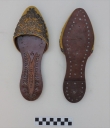
The collection of the TRC Leiden includes a modern pair of mules, 29 x 5 cm, with a yellow vamp, hand-embroidered with metal thread (passing and crinkly purl) and further decorated with glass beads. The embroidery consists of stylised flowers.

The TRC Leiden houses a modern large, red, embroidered and appliqué panel from Pipli, Bhubaneshwar, in Orida (Orissa), India. It measures 88 x 88 cm. It is made of factory produced velvet cloth, hand embroidered with chain stitch, laisy daisy stitch, satin stitch and mirror work.
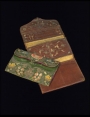
The Victoria and Albert Museum in London houses an embroidered leather wallet, dated 1682, from Ottoman Turkey. It is worked with metal threads and lined with silk. It measures 62 x 23 cm.

The Textile Research Centre in Leiden holds a cotton blouse from Romania. It dates to the 1950s and 1960s and measures 52 x 30 cm. It has a gathered neckline and sleeve heads.

The Victoria & Albert Museum in London holds a pair of embroidered sleeve or trouser cuffs from Armenia, dated to the nineteenth century. They are made of wool with coloured silk threads.
More...

The Georgian National Museum holds a podea that is dated to AD 1773. It measures 148.5 x 151 cm. It is embroidered with gold and silver thread.

The Georgian National Museum holds a late sixteenth or early seventeenth century mitre with images that represent the great festivals of the Georgian Christian Church. The mitre measures 28.5 x 19.5 cm.
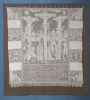
The National Museum Twenthe, the Netherlands, houses a remarkable cloth with the representation of the crucifixion. It measures 300 x 300 cm, and was made of embroidered net lace. It dates to AD 1624.
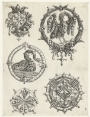
The Rijksmuseum in Amsterdam holds a paper pattern (149 x 113 mm) for embroidery motifs. The patterns, together with other examples that are also housed in the Rijksmuseum, are attributed to Daniel Meijer and are dated to the years between 1618 and 1623. The print was published in Paris. The patterns were designed for goldwork embroidery with gemstones, and may have been used for emblems for high-status people.