
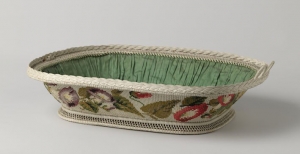
The Rijksmuseum Amsterdam holds a nappy basket that is decorated with Berlin wool work, worked in cross stitch. The white basket measures 12 x 51.5 x 37.5 cm.
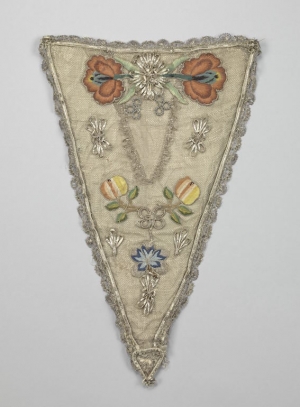
A stomacher was a triangular woman's garment that covered the area between the decolleté and the waistline. These garments were generally decorated, often with embroidery. The Rijksmuseum in Amsterdam houses such a garment (called a devant-de-gorge or borststuk), dating to c. 1750-1775, with an unknown origin. It measures 40 x 25.6 cm.
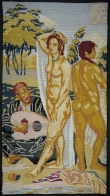
'Deux baigneuses' is an embroidered picture, designed by the French artist, art critic and author, Emile Bernard (1868-1941). It is 177 cm in length and dates to 1904. The woollen embroidery is worked on woollen ground material. It is housed in the Rijksmuseum, Amsterdam.

The Rijksmuseum, Amsterdam, houses a fragment of multi-coloured, embroidered yellow silk that dates to c. 1500 and probably derives from the Ottoman empire (and not from Iran, as suggested in the Rijksmuseum catalogue). The fragment measures 34 x 33 cm.

The Rijksmuseum in Amsterdam houses a small stroke of buratto embroidery that dates to the sixteenth century. It measures 26 x 13 cm. The floral motifs are darned in blue, green, yellow, beige and pink on a warp ground with an even-twined weft. The origin of the stroke is unknown.

The Rijksmuseum in Amsterdam houses a mid-seventeenth century, decorated letter pouch that belonged to the famous Dutch admiral, Michiel Adriaansz. de Ruyter (1607-1676). The pouch is made of green velvet with red leather edges. It was probably made in North Africa. Pieces of leather are sewed onto the velvet on the front of the pouch, and these pieces are embroidered with gold thread. The pouch measures 10.6 x 18 cm.

The lamentation of Christ (De bewening van Christus) is a painting ascribed to the Flemish painter, Rogier van der Weijden (c. 1400-1464) and his atelier, and dated to c. 1460. It measures 80.6 x 130.1 cm and is housed in the Mauritshuis, The Hague, The Netherlands.

The Straatje van Vermeer ('Little Street of Vermeer') is a painting (54.3 x 44 cm) by the Dutch seventeenth century master, Johannes Vermeer (1632-1675). He created the painting around 1658. It shows two houses in the town of Delft, with two alleyways in between, some children playing in front of the house to the left, and a woman in the doorway carrying out what at first glance seems to be her sewing.

Illustrated here is a painting said to be that of Margaret Douglas, Countess of Lennox (1515-1576). Some scholars suggest the painting is that of Mary Queen of Scots. Either person is shown wearing a beautiful black gown with underneath a white chemise decorated at the cuffs and collar with blackwork. The painting is dated to about 1546. The painter is believed to be William Scrots. The painting measures 178.4 x 95 cm.

The Textile Research Centre in Leiden has a woman's collar band from the island of Marken, the Netherlands. It measures 54 x 5 cm. It is made of cotton and embroidered with cross stitch and double running stitch.
More...

The Textile Research Centre in Leiden has a cotton woman's blouse (locally called a pirahan) from Iran, which is decorated with metal thread hand embroidery. It dates to the first half of the twentieth century.

The Textile Research Centre in Leiden has a pair of girl's slippers from Morocco. Localled called babouch, they measure 18 x 9 cm. They are made of leather and hand embroidered with cotton.

The Rijksmuseum in Amsterdam houses a business card for the gold and silver thread shop of Christiaan Beuning, in Beuningen (Gelderland, The Netherlands). It measures 20.4 x 18.1 cm. The engraving is made by Caspar Luyken (1672-1708; see also De Borduurder) and dates to the late seventeenth century.

The Rijksmuseum in Amsterdam houses a knife sheath that dates to the early seventeenth century and was made in the Netherlands. It measures 22 x 2.5 x 3.4 cm. It is made of leather and covered with purple velvet and embroidered with gold and silver thread, pearls and silver sequins.