

The Rijksmuseum in Amsterdam houses a print by the French engraver, Abraham Bosse (1612-1676), showing a lady at her needlework. The print itself measures 21.3 x 14.8 cm.

The Rijksmuseum in Amsterdam houses a hand coloured lithograph published by the firm of Dollfus-Mieg & Cie in 1866, showing a lady wearing a dress ('robe caroline') embroidered with the buteh or paisley motif. The print itself measures 29.7 x 22.7 cm.
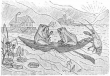
Etching embroidery was a style of working that reproduced line engravings. It was also sometimes used with painting. Etching embroidery, also sometimes known as print work, was carried out with fine black silk over a sepia coloured ground material. It was very popular in Europe in the first half of the nineteenth century. Later in the nineteenth century it was mostly used in outline, rather than for filling-in the illustrations.

Book cushions were used to protect the often precious and highly decorated book (a Bible or Prayer Book) covers while the book was held open upon an altar or lectern. The Victoria and Albert Museum in London houses an English, padded book cushion that dates to about 1625-1650. It measures 28.5 x 20.5 x 9 cm.

The Victoria and Albert Museum, London, houses a beautifully decorated Bible cover that was made in England and dates to around 1650. The cover is made of satin that is embroidered and plaited with silk and silver threads, and further decorated with seed pearls, metal and leather.
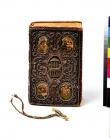
The Victoria and Albert Museum, London, has in its collection a book cover made in England, which dates to about 1634 and measures 17.8 x 12.1 x 6.5 cm. It is made of board covered with satin and embroidered with silver and silver gilt threads, with purl and coil, and with coloured silks and plaited threads.

The Victoria and Albert Museum in London houses an early eighteenth century sampler from England with a representation of Queen Anne (r. 1702-1714). The linen sampler is worked with silk and metal threads, using chain stitch, cross stitch, satin stitch and split stitch. The sampler measures 31.8 x 22.8 cm.

The collection of the Textile Research Centre (TRC), Leiden, includes a typical woman's faceveil from the southern Sinai. Measuring 74 x 54 cm and locally called a burqa, it has a yellow head band decorated with beading.

The Textile Research Centre (TRC), Leiden, houses a necklace from among the Turkmen in northeastern Iran. The object is made of cotton, glass, metal and plastic. The necklace measures 39 x 10 cm.

The Textile Research Centre (TRC), Leiden, houses a woman's quilted cap from Niederhessen, Germany. The cap dates to the second half of the nineteenth century. The cap itself measures 16 x 11 cm. The four tassels are 60 cm long. The cap is made of black silk with decorative hand quilting and two pairs of black silk ribbons.
More...
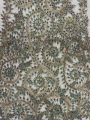
The Victoria and Albert Museum in London houses a cloth from Chennai (Madras), India, that around 1880 was made at the Hobart School for Mussulman Girls, perhaps as a sample for the export. It is decorated with gold thread embroidery (zardozi) and beetlewing cases attached to net.

The Textile Research Centre (TRC), Leiden, houses an embroidered panel from among the people of the Hmong in mainland Southeast Asia. It measures 41.5 x 36.5 cm. It was acquired in 1991 in California, USA, during a special meeting set up to support Hmong refugees.

The Textile Research Centre (TRC), Leiden, houses a remarkable sampler (merklap) that dates to the eighteenth century or earlier and is made of linen worked with silk (pulled cross stitch).

The Textile Research Centre (TRC), Leiden, holds a pair of embroidered women's shoes from Afghanistan, made of leather and velvet. They measure 22 x 7 cm. The decoration consists of metal thread embroidery and couching.