

The Textile Society was established in 1982 during a conference at the Whitworth Art Gallery in Manchester, UK. It promotes the study of textiles and their history, both traditional and contemporary. The Society supports students, designers, historians and practitioners through its educational and professional awards. The Society's Journal, TEXT, is published annually.
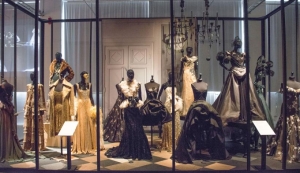
The Textile Museum (Textilmuseet) of Sweden is since 2010 located in the Textile Fashion Center, in Borås, Sweden. Its collection mainly consists of garments and textiles from West Sweden, but also contains items from other parts of the country and beyond. There is also an extensive sample and reference collection.

The Prato Textile Museum (Museo del Tessuto di Prato), Prato, Tuscany, Italy, houses thousands of textiles from Italy, Europe and from the rest of the world. The most ancient conserved textiles are from the pre-Columbian burials and from Coptic Christian Egypt. The collection of Italian Renaissance textiles is one of the most important in the world.

The German Textile Museum (Deutsches Textilmuseum) in Krefeld-Linn, Germany, houses a collection that has been steadily growing, ever since its inception in 1881. It now includes some thirty thousand textile objects from all over the world, and from all ages. It also has a library, and it sets up regular exhibitions.

The Abegg Stiftung (Foundation) in Riggisberg, Switzerland, was set up in 1961 by Margaret and Werner Abegg. Its aims are to collect, exhibit, conserve and restore, and study textiles and other items of art and craft from Europe, the Middle East and Central Asia. Apart from an extensive collection it also houses a large library.

The Ashmolean Museum in Oxford, England, houses a large collection of textiles from all over the world. It includes a large collection of English embroideries, including 61 seventeenth century pieces donated by the collectors Micheál and Elizabeth Feller. The Ashmolean also houses the Newberry Collection of Islamic Embroideries.

The Gallery of Costume in Manchester, England, houses one of the largest collections of clothing and fashion accessories in Britain (over 20000 items). It is housed at Platt Hall, an eighteenth century textile merchant’s home.

The Northampton Borough Council’s Northampton Museum & Art Gallery houses the largest collection of objects relating to history of shoes in the world. It includes 12000 shoes and 50000 archival records including documentary footage and fine art.

The Deutches Historisches Museum, formerly the Museum für Deutsche Geschichte, in Berlin houses a large collection of some 20000 mainly German, items of textiles and dress, from about 1750 to the present day.
More...

The Textile Research Centre (TRC), Leiden, houses a beautifully embroidered woman's waistcoat that derives from Hungary and dates to the late twentieth century. It measures 47 x 44 cm. It comes from the region of Matyo, and the decoration is characteristic for the area. The waistcoat is made of (factory made) black felt, decorated with rayon thread.
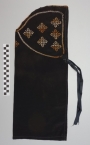
The Textile Research Centre (TRC) in Leiden has a black Coptic monk's hood, called a qalansuwa (TRC 2001.0248). It measures 53 by 23.5 cm and is made of synthetic material and embroidered with brown ombré cotton thread. The embroidery is worked in cross stitch and herringbone stitch.

The Textile Research Centre, Leiden, houses a remarkable darning sampler which dates to 1781 and originates from Zeeland, in the southwest of The Netherlands. It is worked in silk thread on a linen ground. It has M R V D B OUD 13 JAAR 1781 (MRVDB aged 13 years 1781) embroidered on it using cross stitch.