

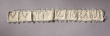
The Rijksmuseum in Amsterdam houses a linen strip of embroidered lace that dates to the late sixteenth century and derives from Italy. The scalopped edge is made of punto in aria needle lace. The strip is 60 cm long.
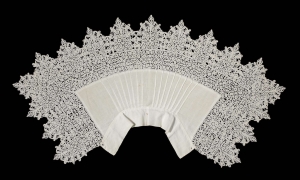
The Rijksmuseum in Amsterdam houses a remarkable lace collar. It dates to about the second quarter of the seventeenth century. It was sewn in The Netherlands, but the lace itself was probably made in Italy. The collar consists of a linen main piece offset with a large panel of lace. The lace attached to the linen main piece is worked in reticella with square shaped motifs. The scalloped edge is worked in punto in aria.
The Rijksmuseum in Amsterdam houses a ribbon (originally in orange; in Holland called an Oranjelint), on which are embroidered the letters: VIVAT P.W.V. ORANJE ('Long live Prince Willem of Orange'). The sash is made of silk and measures 33.5 x 5 cm.
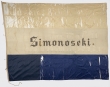
The Rijksmuseum in Amsterdam houses the ship's flag of the Dutch navy steamer 'Medusa', presented to the ship's crew by King Willem III in 1865 in recognition for their role in forcing the Straits of Shimonoseki during the international punitive expedition against the Prince of Nagato (Japan).
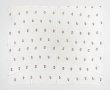
The Rijksmuseum in Amsterdam houses an ivory-coloured piece of cloth made of cotton, powdered with embroidered sprigs of rose-red flowers on a green stem, worked in silk. The cloth originates from India and dates to the late eighteenth century and measures 114 x 137 cm. It may have been part of a dress, or intended to be so, for a woman in early nineteenth century Europe.
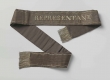
The Rijksmuseum in Amsterdam houses a remarkable shoulder sash with the embroidered text: "Representant". It was worn by Jan Couperus (1755-1833), the 'representative' from the Dutch town of Gouda at the national convention (Nationale Vergadering) in The Hague, which was elected in 1796 by all men in The Netherlands who did not live on social welfare. All 126 representatives wore a sash.

The Rijksmuseum Amsterdam houses a bookcase with a large embroidered panel. The item dates to around 1840 and was produced in The Netherlands. The bookcase measures 219 x 112.5 x 50 cm.

A beautifully embroidered settee dating to the end of the seventeenth century is housed in the Victoria and Albert Museum, London. The settee's upholstery is decorated with floral motifs worked with cross stitch canvas embroidery in wool on a silk background. The settee itself, measuring 137.8 x 157.5 x 95 cm, is made of walnut and beech. The cushions are lined with kidskin.
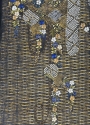
The Victoria and Albert Museum, London, houses a small fragment of a kimono that dates to the late sixteenth or early seventeenth centuries. It is made of monochrome figured satin silk (rinzu) with applied gold leaf decoration (surihaku, tie-dyeing (kanoko shibori) and embroidery with silk and metal threads. The fragment measures 58.5 x 30 cm.

The Metropolitan Museum of Art in New York houses a woman's ceremonial outer robe (uchikake) that dates to the late eighteenth or early nineteenth century. It is made of tie-dyed satin damask with silk embroidery and gold thread couching. The robe, which measures 176.5 x 123.2 cm, was traditionally worn without a sash on top of another robe called the kosode.
More...
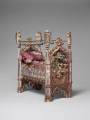
The Metropolitan Museum of Art in New York houses a fifteenth century wooden crib of the Infant Jesus that derives from what is now Belgium, and was used in the town of Louvain (Leuven). The pillow and coverlet inside the crib are decorated with silk embroidery with seed pearls, gold thread and translucent enamels. The crib measures 35.4 x 28.9 x 18.4 cm. The embroidery on the bedcover shows the family tree of Christ.

The Victoria and Albert Museum, London, houses a gold pendant with a border of half pearls surrounding an embroidery of two birds under faceted crystal. The pendant dates to c. 1700 and measures 2.7 x 2.4 cm.

An embroidered tea caddy or tea canister dating to the early nineteenth century is held in the Victoria and Albert Museum, London. The caddy is made of rolled paperwork and wood. The object is signed in embroidery with the name of M. Skeet and that of Melford School. M. Skeet was probably the embroideress, Mary Skeet (1807-1885), who was the daughter of the landlord of The Greyhound Inn in the village of Lavenham, near Long Melford in Surrey.
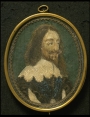
The Victoria and Albert Museum in London holds an embroidered picture of Charles I, worked by an unknown embroiderer, but based on an engraving by Wenceslaus Hollar (1607-1677), dated 1641. The embroidery is carried out in silk on a satin ground material.