
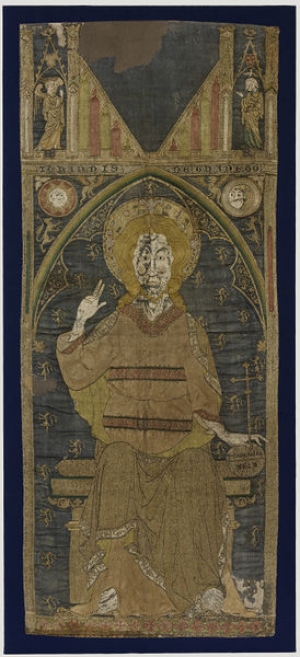
The Victoria and Albert Museum, London, houses the so-called John of Thanet panel, which was attached to the back of a cope. The panel dates to the early fourteenth century. It measures 99 x 42 cm. The panel is made of silk with silver-gilt, silver and silk thread, and pearls. It is a prime example of Opus Anglicanum.

The Haslemere Peasant Industries is the general name given to a group of industries, workshops and societies that were set up in the late nineteenth century in Haslemere, Surrey, England. By that time, this place had become an attractive residence for various artistic people, moving from London, enjoying the country life. Among them was the poet laureate, Alfred Lord Tennyson.
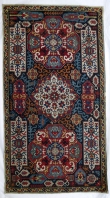
The Victoria and Albert Museum, London, houses a piece of cloth, perhaps the cover for a cushion, which is made of cotton embroidered with silk worked in cross stitch. It measures 130 x 70 cm and is dated to the late seventeenth century. Formerly this style of work was regarded as copying knotted carpets, but some scholars now regard the embroideries as providing the original motifs.
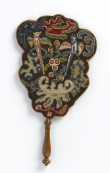
An embroidered fire screen dated to around 1700 and originating from The Netherlands is housed in the collection of the Rijksmuseum in Amsterdam. The screen has a linen cloth that is embroidered on one side with multi-coloured wool, and on the other side printed with a putto motif. The screen itself measures 26 x 20 cm.
An embroidered woollen Kashmir shawl dating to the (mid-) nineteenth century and probably produced in Kashmir is housed in the collection of the Rijksmuseum in Amsterdam. It measures 137 x 126 cm. The embroidery is worked with a stem stitch.
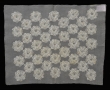
The Rijksmuseum in Amsterdam houses a piece of net (45 x 35 cm) that has been embroidered in preparation of being used as the crown section of a lace cap (hul). The embroidered net lace decoration consists of 41 rosettes. It dates to the nineteenth century. Such decoration is typical for the traditional lace caps worn by women in West-Friesland, in the north of the province of Noord-Holland, in The Netherlands.

The Rijksmuseum in Amsterdam houses a sampler made of a piece of net or tule that has been decorated with a variety of different patterns and techniques of embroidered net lace. The sampler measures 19 x 9 cm.

An embroidered linen parasol acquired in The Netherlands and dating to the early twentieth century is housed in the collection of the Rijksmuseum in Amsterdam. The parasol is light brown, and is decorated with cutwork and bouquets of tulips that are embroidered with floss silk in satin stitch. The parasol has a length of 95.2 cm.

The Rijksmuseum in Amsterdam houses an embroidered picture (tableau) made in The Netherlands (Amsterdam?) by the textile atist Wynant Haelwegh (born 1617/16180) in 1650 (according to the embroidered text in the bottom right-hand corner). It measures 51 x 36.5 cm. The embroidery is worked in silk on a silk ground. It shows a large vase with a bouquet of flowers.