

'Beyond the Chador: Dress from the mountains and deserts of Iran' was the name of an exhibition mounted by the Textile Research Centre in Leiden, from 23 January until 29 August 2013. Visitors at the exhibition were struck by the sheer diversity, the bright colours of the garments and multitude of shapes, which constitute such a marked contrast with the dominant perception of Iranian clothing as being dull and uniform.
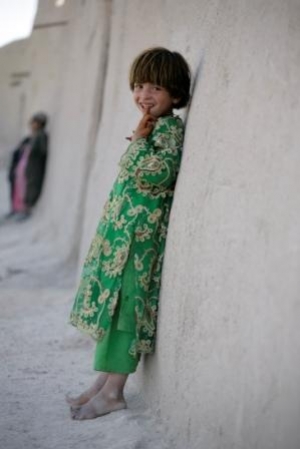
'Well-Dressed Afghanistan' was the name of an exhibition set up at the Textile Research Centre in Leiden, from November 2010 until March 2011.
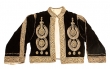
'Embroidery from the Arab World' was the title of an exhibition mounted by the Textile Research Centre in Leiden, between May and August 2010. This was the first time in The Netherlands that an exhibition was dedicated to the various types of embroidery from the Arab world.
From September 2013 until March 2014, the Textile Research Centre in Leiden organised an exhibition named 'What is Embroidery?' The exhibition showed a wide range of examples of embroided cloths and garments from all over the world, emphasizing the wide variety of materials, techniques, designs and colours.
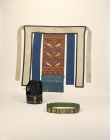
An embroidered apron from about 1900 is housed in the Victoria and Albert Museum, London. It has a satin ground material and is worked with silk and gold thread. It was acquired in Seoul in 1919 by a Christian missionary. The panel is attached to a white silk band (daedae) outlined in black. The apron, called a husu in Korean, was worn at the back, together with a hat and another belt (see illustration).
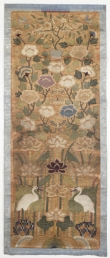
A Korean panel with a length of 125 cm and with fine embroidery is housed in the Victoria and Albert Museum, London. The panel is worked on a silk ground material with gold paper thread and silk thread. The panel was used for the over-robe of a Korean bride in the late eighteenth or early nineteenth centuries. She would wear this over-robe at her entrance to her new husband's family home.
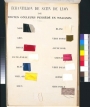
A book (76 x 42 cm) with samples and patterns from c. 1920 now in the Victoria and Albert Museum, London, derives from Vietnam and was used by the firm of Nam-Quat. It was probably used to show customers the wide range of embroidery products (cloth; threads) and designs that could be commissioned from the firm. The final page of the book contains silk satin samples in twelve different colour ways.

An embroidered silk satin roundel, 25 cm in diameter, with floss silk embroidery now in the Victoria and Albert Museum, London, was made in China and dates to the nineteenth century. The roundel shows one of the mythological eight immortals, namely He Xian'gu, set in a garden.

From 5th September 2012 until 17th January 2013, the Textile Research Centre in Leiden organised an exhibition about footwear from all over the world. It included a number of delicate lotus shoes from China (from 5 to 12 cm in length for an adult woman). They were part of a growing collection of lotus shoes that the TRC has been building up since 2007.

A pair of nineteenth century lotus shoes is housed in the Victoria and Albert Museum, London. They are made of silk, cotton and wood. The shoes show traces of wear, and were therefore probably used, rather than made for the tourist market. The shoes are 16 cm long, 5 cm wide and 8 cm high and were probably worn by a bride.
More...

A Chinese bed cover now in the Victoria and Albert Museum appears to have been produced in China for the export market. It dates to sometime between 1550 and 1750. Although now of a vermillion colour, originally it must have had a brightly red ground material. The cover shows a large degree of Portuguese influence. It measures 259 x 208 cm.

The Museum Schaustickerei in Plauen, Germany, houses a large collection of embroidery machines. Plauen is the city where the first hand-embroidery machine was developed that produced tulle lace (in 1881). The museum is housed in a former factory building where machine made embroidery was produced since 1889.

"Nyonya Needlework: Embroidery and Beadwork in the Peranakan World" is the title of an exhition that was on display from 24th June 2016 until March 2017 at the Peranakan Museum in Singapore. This exhibition celebrated the art of Nyonya ('women's') needlework, a vibrant part of Peranakan Chinese heritage.

The Resistance Museum (Verzetsmuseum) Amsterdam houses a number of special objects that are closely related to the war-time period of German occupation of The Netherlands between 1940 and 1945. Some of these objects were on display at the 2012 exhibition Elke dag een draadje …Borduren in gevangenschap 1940-1945 ('Everyday a little thread. Embroidering in prison, 1940-1945').