
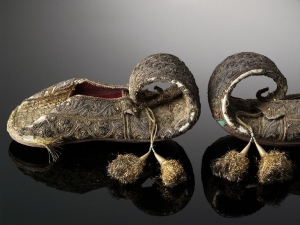
The Victoria and Albert Museum in London houses a pair of embellished Oriental shoes (mojaris) that were acquired in Lucknow, India, in 1855. They are made of leather and cotton, and embroidered with silk and with coiled and twisted silver and gilded silver threads, and further embellished with hundreds of spangles.
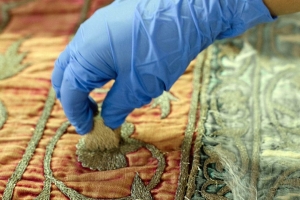
The Lal Dera ('Red Tent') or the Shahi Lal Dera ('Royal Red Tent) is housed at the fort of Mehrangarh, in Rajasthan, India. It is believed to have been used by the Mughal emperor Shah Jahan (1592-1666), who is known for commissioning the construction of the Taj Mahal mausoleum at Agra, or by his successor, Aurangzeb (r. 1658-1707). The origin of the tent, however, is still disputed, and it may have been produced locally.
Cannetille is a spirally twisted thread of gold or silver. It is applied in jewelry, especially in the early nineteenth century, but it also used for embroidery, for military braid or made into lace.
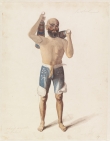
The Victoria and Albert Museum in London holds a water colour by Godfrey Vigne, who was a British adventurer who in the 1830's travelled in the Indo-Iranian borderlands. This water colour shows a wrestler with his characteristic knee-length, embroidered shorts, which he wears in the zur khana, or 'house of strength'.
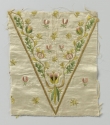
The collection of the Rijksmuseum in Amsterdam includes a fragment of white silk with polychrome floral embroidery. It dates to c. 1680 and probably was made in Holland. It measures 21.7 x 18.2 cm. The V-shape may indicate its use as a stomacher.
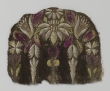
The Rijksmuseum in Amsterdam houses a fragment of dark silk with embroidery in red, silver and yellow. It probably derives from Germany and was made in the mid-seventeenth century. It measures 17 x 20.5 cm. Half beads have been sewn in between the embroidered motifs.

The collection of the Rijksmuseum in Amsterdam includes a fragment of blue silk that is embroidered with white flowers (daffodils, tulips, lillies). It dates to c. 1630 and probably was made in Holland. It measures 30 x 39.5 cm.

TRC Needles is a digital encyclopaedia that has been set up by the Textile Research Centre (TRC) in Leiden. It covers the enormous field of needlework, focussing in particular on appliqué, beading, darned knotting, embroidery, needle lace making, passementerie, patchwork and quilting.

In 2016, Newcastle auctioneer Anderson & Garland announced that it would bring a pair of silk, embroidered stockings of Queen Victoria (1819-1901) under the hammer. She allegedly wore the stockings in the 1840's. They were sold for 220 pounds.

Blonde lace (also written as blond lace) is a form of bobbin lace made of silk and produced in strips of some ten cm wide. It was particularly popular in the eighteenth and early nineteenth century and principally made in France. The name refers to the natural colour of the silk thread, but much of the blonde lace was made in black.
More...

The queen stitch is a composite stitch that is generally worked on a canvas and forms a diamond shape. It is mentioned by the poet John Taylor (1578-1653). The technique is also known as the Renaissance stitch or rococo stitch.

The collection of Museum Rotterdam houses a sampler from the second half of the eighteenth century worked in queen stitch with coloured silk threads on a loosely woven linen fabric. It measures 32 x 31.5 cm.