

Thimble

A thimble is a bell or ring shaped sheath with a hard substance, such as bone, leather, metal or wood. It is worn on the tip or middle of a finger or thumb to help push a needle while sewing and to protect the finger/thumb from being pricked. Many thimbles are pitted to help hold the needle in place. Thimbles made of precious stones, mother-of-pearl, glass or porcelain are usually for decorative, rather than functional purposes.
Gu Embroidery

Gu embroidery is a style of Chinese decorative needlework that originated during the late Ming Dynasty (1368-1644) and was very popular well into the Qing Dynasty (1644-1911). The embroidery is worked with fine floss silk thread in various colours on a silk background.
Functional Needle Project
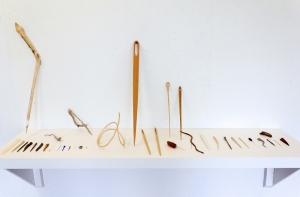
The Functional Needle Project was a textile installation set up in Canada in 2014. The project leader was the textile artist, Aram Han Sifuentes. The aim of the project was to explore the role of hand work.
A Grain of Truth

'A Grain of Truth' is a textile installation by Aram Han Sifuentes, who was inspired by the traditional Asian mythology of the Rice Goddess or Rice Mother. There are many versions of the tale, but basically it tells how a mother is killed and the first rice grows from her body. Due to the sacrifice of her body, rice feeds over half of the total world population today.
US Citizenship Test Sampler

The US Citizenship Test Sampler is a project begun in 2012 by the fibre artist, Aram Han Sifuentes (Chicago). It involves stitching a sampler with all of the one hundred questions and answers that are used for the US Citizenship and Naturalization test.
Aram Han Sifuentes

Born in Seoul, South Korea and having emigrated with her family to Modesto, California (USA) in 1992, she earned her BA in Art and Latin American Studies from the University of California, Berkeley in 2008. She then went on to gain a Post-Baccalaureate Certificate in Fine Art from the Maryland Institute College of Art in 2011, followed by an MFA in Fiber and Material Studies from the School of the Art Institute of Chicago in 2013.
Smoking Caps

In the nineteenth century, a form of man’s indoor cap, called a smoking cap, became very popular among urban groups in Europe and elsewhere. This type of cap was particularly popular from the late 1840's until the 1880's.