

Dura Europos Embroidery
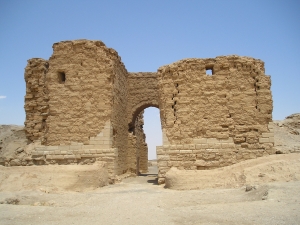
Dura Europos was a border city built on an escarpment above the Euphrates river. The site is located near the modern village of Salhiye in Syria. The city is believed to have been founded around 303 BC at an intersection of east-west trade routes between Central Asia/China, Iran and the Mediterranean Sea and a north-south route up and down the Euphrates.
Halabiyeh

The fortress of Halabiyeh, ancient Zenobia, lies along the Euphrates River near the modern city of Deir ez Zor, Syria, about 200 km northwest of another ancient site, Dura Europos. Halabiyeh is first mentioned in a list of Assyrian settlements from c. 1040 BC. The town became an important trading centre between east and west, and remained inhabited until at least the seventh century AD.
Palmyra Embroidery
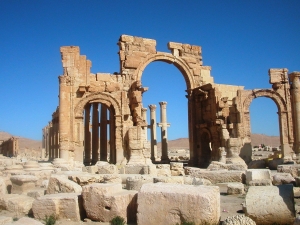
The ancient city of Palmyra, Biblical Tadmor, lies in an oasis to the northeast of Damascus, in Syria. It was an important caravan city for goods being transported across the Syrian desert to and from the Eastern Mediterranean and Iran, Central Asia and China. The decline of Palmyra started in the early third century AD and by c. AD 800 much of the city had been abandoned. By the medieval period it was reduced to an oasis village. The site was seriously damaged by ISIS in the mid-2010s.
Horizontal Cross Stitch Couching
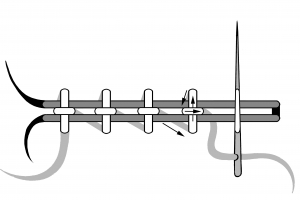
Horizontal cross stitch couching is a variation on couching, whereby a horizontal cross stitch is used to fasten down the laid threads rather than using other forms of stitches. This type of stitch is used for free-style embroidery. It is also associated with North African and Middle Eastern embroidery.
Brick Stitch Couching
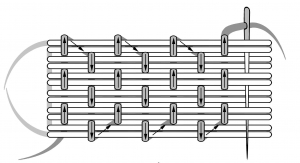
Brick stitch couching is a variation on couching, whereby a brick stitch is used to fasten down the laid threads rather than using other forms of stitches. This type of stitch is used for free-style embroidery. It is also associated with North African and Middle Eastern embroidery.
Chain Stitch Couching
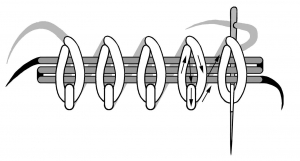
Chain stitch couching is a variation on couching, whereby a detached chain stitch is used to fasten down the laid threads rather than other forms of stitches. This type of stitch is used for free-style embroidery. It is also associated with North African and Middle Eastern embroidery.
Fly Stitch Couching

Fly stitch couching is a variation on couching, whereby a fly stitch is used to fasten down the laid threads rather than other forms of stitches. This type of stitch is used for free-style embroidery. It is associated with North African and Middle Eastern embroidery.
Split Chain Stitch
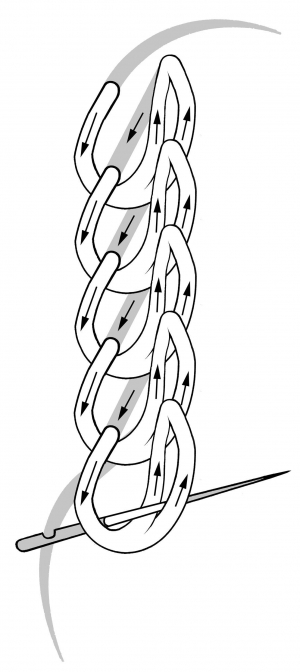
The split chain stitch is a variation on a chain stitch, whereby the working thread is taken under the ground cloth, but instead of it coming up at the bottom of the loop, the point of the needle ‘splits’ the working thread. This type of stitch is used for free-style embroidery.
Appliqué Mamluk Emblem

This illustration shows an example of an Egyptian appliqué Mamluk emblem that dates to the fifteenth or sixteenth centuries. Such emblems were used to show a man’s rank within the bureaucracy of the Mamluk empire. The emblem is made out of a yellow woven cloth with appliquéd mid-blue and light blue, red and white woollen cloth. Each of the devices is outlined in a couched, cotton cord.
Leather Mamluk Emblem
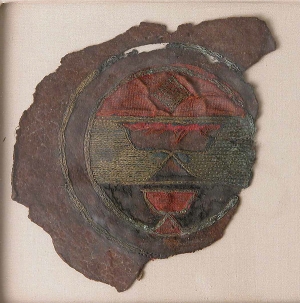
Illustrated here is an example of a leather Mamluk emblem that dates to the fifteenth century or slightly earlier. This particular example takes the form of a triple field shield with devices in the form of a diamond and two chalices.