

Detached Twisted Fly Stitch
The detached twisted fly stitch is a variation on the fly stitch, in which a loop is created by crossing over the two arms of the stitch.
Detached Twisted Fly Stitch with Chain Stitch Fastening

The detached twisted fly stitch with chain stitch fastening is a composite stitch, which is made up of a row of detached twisted fly stitches fastened down with a chain stitch. This type of stitch is used for free-style embroidery and is associated with Saudi Arabian and Yemeni embroidery.
Square Fly Stitch
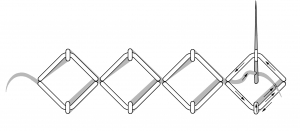
A square fly stitch creates diamond shapes using two fly stitches. These diamonds may be left ‘empty’ or filled in using another stitch type, such as satin stitch or blanket stitch. This type of stitch is often used for free-style embroidery. GVE
Basketweave Stitch
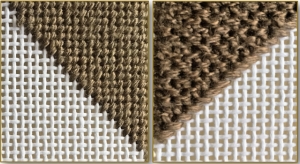
The (needlepoint) basketweave stitch (also known as the basketweave tent stitch) is a form of tent stitch. It passes diagonally over the intersection of the horizontal and vertical threads of a canvas. Each stitch follows the preceding one in a diagonal line. The stitching is reversed at the end of each line. See also basketweave.
Double Coral Stitch
Double Feather Stitch
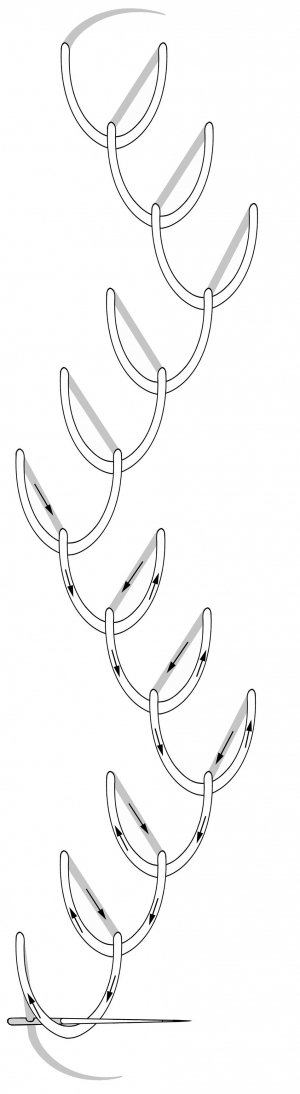
A double feather stitch is a variation on the feather stitch, in which two or more stitches are worked consecutively before the angle of the stitches changes to create the characteristic zig-zag effect. This type of stitch is used for free-style embroidery. It is also sometimes called a double coral stitch.
Basket Filling Stitch
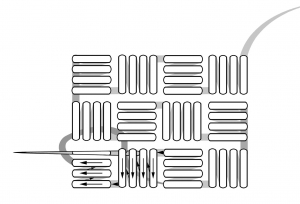
The basket filling stitch (also known as the basket satin stitch) is a form of filling stitch, in which three to five satin stitches are worked in alternating horizontal and vertical blocks to produce a basket weave pattern. The basket filling stitch is generally used for counted thread work. It is not the same as a basket stitch or a basket weave stitch.
Detached Cross Stitch

The detached cross stitch is a variation on a cross stitch, in which each complete cross is worked in isolation from the cross stitch on either side of it. This type of stitch is used for both counted thread work and free-style embroidery.
GVE
Embroidered Court Mantua

The illustrated garment is an example of an English lady’s court outfit made from silver embroidered silk cloth. The mantua (from French manteau) dates from c. 1745 and represents one of the most formal forms of English dress of the period. A mantua is a combination of garments, including a skirt with train at the back, a jacket, a stomacher and a petticoat.
Early Chinese embroidery from Dunhuang

Some extant Early Chinese embroidery from Dunhuang, western China, is housed in the British Museum and the Victoria and Albert Museum (both in London). The Dunhuang embroideries derive from excavations and clearings in the early twentieth century under the direction of Sir Aurel Stein (1862-1943). They date from the second half of the first millennium AD.