

Tambour Work
See tambour embroidery.
Cats and Fishes: Chancay Open Weave Darning (Peru)
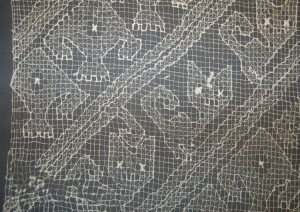
In the British Museum collection there is a fragment of Chancay open weave darning. The cloth is believed to come from the Chancay culture in Peru and dates from sometime between 900 – 1430 AD. It derives from burial excavations in the Pacasmayo Valley carried out in the late nineteenth and early twentieth centuries. The design on this textile consists of alternating, diagonal rows of feline and fish motifs.
Chancay Open Weave Darning (Peru)

Chancay open weave darning is a form of darned embroidery, in which the open weave gauze ground is decorated using both thick and thin white cotton threads. The outlines of the individual motifs are worked into the gauze ground. They are made with a thick thread that is looped and/or worked around the ground mesh intersections using a long stem stitch.
Samoan Sampler (Samoa)

In the British Museum, London (Oc1848,0216.1), there is a sampler that comes from a missionary school in Samoa, one of the Pacific Ocean group of islands. It is 31 x 21 cm in size and dates to about 1844. The sampler is in a traditional, North European form with rows of letters and numbers worked in cross stitch using red and blue woollen thread on a linen ground.
Nasca Sample (Peru)
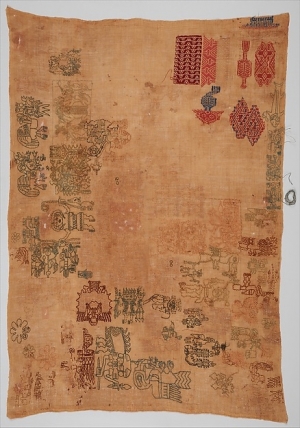
An early form of a needlework sample (often classed as a sampler) from Nasca, Peru, is kept in the Metropolitan Museum of Art, New York (USA). The sample dates to the second century BC. It is 105 x 72 cm in size. A sample is a piece of cloth on which motifs and stitches are worked out in a random manner. The aim of this type of textile is to act as a private ‘sketch pad’ to remind the embroiderer of techniques and ideas.
Camel Saddle Cloth (Ethiopia)
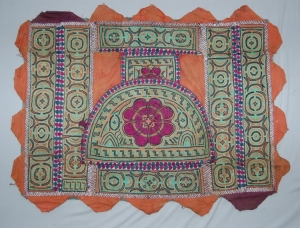
The British Museum in London houses a remarkable, decorated camel saddle cloth (acc. no. Af1947,15.4). It comes from Ethiopia and dates to the first half of the twentieth century. The ground cloth is 107 x 83 cm in size and is made from orange cotton with appliqué green leather strips.
Ghulam Haidar Khan (1816-1858)
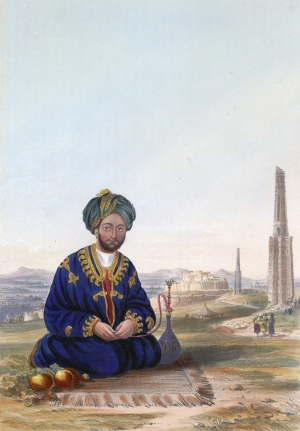
Ghulam Haidar Khan was a son of Dost Mohammed Khan, emir of Afghanistan. This lithograph is by E. Walker and based on the work of James Rattray (1818-1854), who joint the British Indian forces that invaded Afghanistan in 1838 during the First Anglo-Afghan War (1838-1842) and who made numerous drawings and water colours of Afghanistan and its people.
Pomander Purse in the British Royal Collection

In the Royal Collection (London, UK) there is a small embroidered bag or purse that was used to carry scented substances. Such bags, and the contents, were called pomanders. The English word pomander derives from the French pomme d’ambre (lit. ‘apple of amber’), and was used for a mixture of various aromatic substances usually formed into a ball.