

Faggoting

Faggoting is a technique of sewing two hemmed pieces of textile together with (decorative) stitching, creating a zigzag pattern, but leaving a narrow gap in between. Also known as twisted insertion stitch. It was particularly used in the nineteenth century for ladies' underwear.
Needleweaving
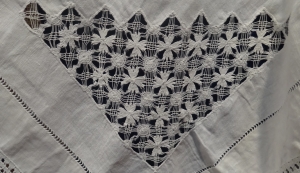
Needleweaving is a form of drawn thread work that involves darning or re-weaving patterns on bare warp or weft threads. The term needleweaving is sometimes used for a form of decorative darning ("chicken scratch").
Jacobean Work

Jacobean work may be regarded as a form of crewel embroidery, although it also uses silk or even metal thread. It is characterised by its floral designs, but it also includes animals, birds, etc. It became popular in England in the early seventeenth century, in the reign of James (Jacobus) I. A portrait of Queen Elizabeth I, from c. 1599, heralds this style of embroidery (see the pertinent entry).
Oxburgh Embroidered Hangings
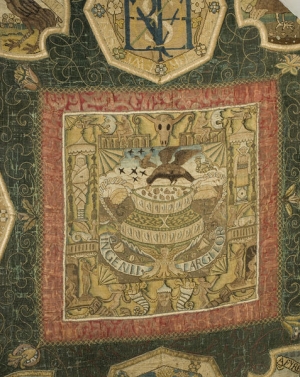
The Oxburgh hangings are several long lengths of green velvet, which were made into a wall hanging, two bed curtains and a valance. They include the so-called Shrewsbury Hanging and the Cavendish Hanging. They are decorated with over one hundred applied panels called slips, which are decorated with counted thread embroidery. In addition there are 33 loose slips.
Pearl Stitch
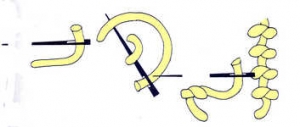
A pearl stitch is mainly used for providing an outline for a certain motif or area. It consists of a small straight stitch, leaving a tiny loop on the obverse of the fabric. The needle is next brought up in the middle of the stitch, taken around the loop and fastened again by passing the needle and thread through the fabric, thus creating a little knot in the middle of the straight stitch.
Mahdi Army Quilted Garment
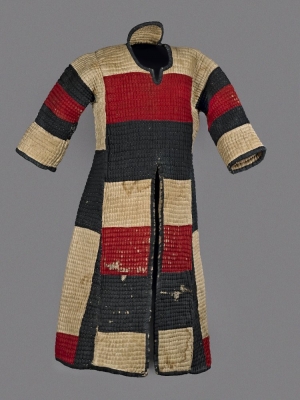
This example of quilting is used for a ‘suit of armour’ for a horseman. The quilt is made from two layers of natural cotton material, with a wadding layer in between of raw cotton. The decoration consists of bands of red and dark blue cotton cloth sewn (applied) onto the cotton ground. The stitching of the quilting takes the form of horizontal rows of small running stitches worked in a thick, cotton sewing thread.
African Quilted Armour
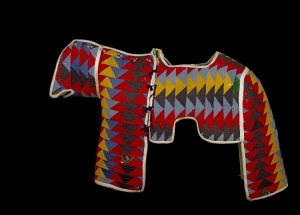
Quilting is not widely found in Africa. However, there is a significant exception, namely the quilted armour found in parts of sub-Saharan and eastern Africa. In particular, the practice of quilted armour seems to cover an area as far west as the Djerma people of the middle Niger and as far east as Khartoum in Sudan. The armour was made for both warriors and their horses.
Medieval Quilted Helmet

In medieval Europe, a special type of helmet was made from plates of iron sewn between layers of linen. In the British Museum, London, there is an example of such a helmet (acc. no. 1871,1208.1). The helmet is 21.5 cm high.
Armoured Doublet from England
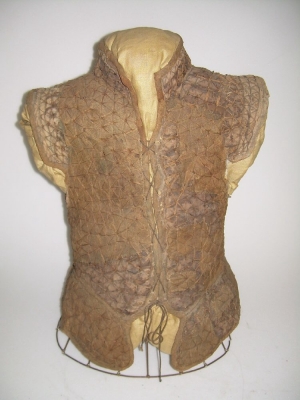
In medieval Europe, a special form of armour was being worn, called either a jack or a jack of plate. It was the medieval equivalent of a bullet-proof vest. A jack of plate takes the form of a doublet with a series of small iron plates sewn (quilted) between layers of canvas and sometimes felt. This type of armour may weigh about 7.5 kg.