

British Light Dragoon Sabretache

In the Royal Collection, London, UK, there is an example of an embroidered sabretache, which was a cavalry officer’s satchel. This style of sabretache is associated with the Light Dragoons, a British cavalry regiment. A sabretache is a flat pouch or satchel with long straps worn by some cavalry and horse artillery officers from the left of the waist belt near to the officer’s sabre.
Sabretache
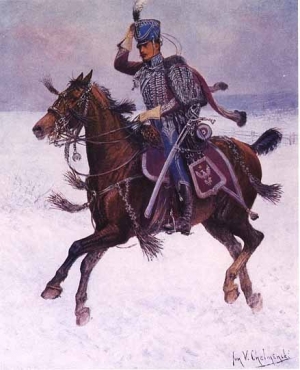
A sabretache is a flat, leather pouch or satchel with long straps traditionally worn by some cavalry and horse artillery officers from the left-hand side of the waist belt near to the officer’s sabre. The term sabretache is an early nineteenth century term that derives from the German word Säbeltasche (Säbel ‘sabre’ and Tasche ‘pocket’) and the French version sabretache.
Great Royal Seal Bag of Henry III (1207-1272)
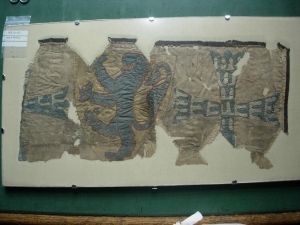
Fragments are kept in the British Museum, London (acc. no. 1856,0819.1), of a linen bag decorated with appliqué and silk embroidery. They are all that is left of a Great Seal bag of King Henry III, who reigned in England from 1216 to 1272.
Pearl Dress of Lupita Nyong'o

The Kenyan actress, Lupita Nyong’o (b. 1983), wore a long, holder-necked dress decorated with applied pearls to the Oscar film award ceremonies on 22nd February 2015. In 2013 she had won an Oscar for her role as Patsey in "12 Years a Slave" and she was one of the presenters at the 2015 event.
Mahdi Flag

The Mahdi flag now in the British Museum, London (BM acc. no. AF1949,46.694.b) represents a particular type of flag used by the Mahdi and his followers in the late nineteenth century. The Mahdi army used two types of flags to indicate the position of their leaders.
Osman Digna's Tunic
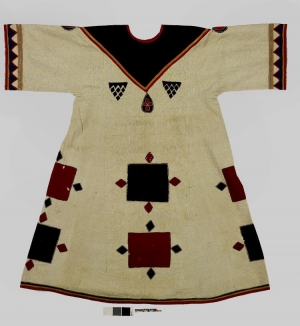
This tunic in the collection of the British Museum is part of an outfit associated with Osman Digna (c. 1840-1926), who was a follower of Muhammad Ahmad (the Mahdi), in Sudan. Osman Digna was regarded as one of the ablest generals in the Mahdi army. In 1899 he fought in the last campaign of the Mahdist forces. In 1900 he was captured near Tokar and was to serve eight years in prison in Egypt. He died there in 1926.
Mahdi Tunics
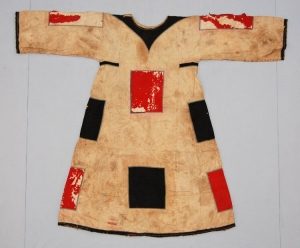
The so-called Mahdi tunics (jibba), decorated wih appliqué, were worn by the followers of Mohammad Ahmad bin Abd Alla (1844-1885). He was a Sufi sheikh from the Sudan who in 1881 proclaimed himself the Mahdi (messianic redeemer of the Islamic faith). This took place at a time of growing local resentment against the policies of the Ottoman-Egyptian rulers and the growing power of the British.
The Mahdi and Decorative Needlework
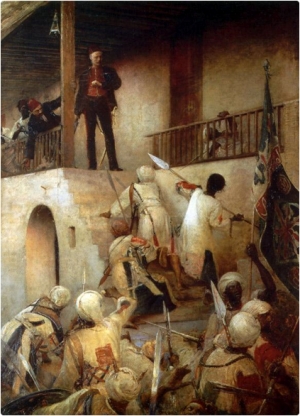
Mohammad Ahmad bin Abd Alla (1844-1885) was a Sufi sheikh in Sudan who proclaimed himself the Mahdi in 1881. The rise of the Mahdi took place during a period of growing local resentment against the policies of the Ottoman-Egyptian rulers and the growing power of the British. Mohammad Ahmad used the messianic beliefs of the time to propagate a ‘purer’ Islamic state.
Embroidered Watch Paper

In mid-eighteenth century Northern Europe and North America, it was not uncommon for a small, circular shape of cloth (c. five cm in diameter), sometimes mounted on a piece of card, to be placed between a watch case and a pocket watch in order to protect the watch glass.
The Last Runaway

The Last Runaway is a novel by the American author, Tracy Chevalier. Its main themes are quilting and head coverings (millinery). It was published in 2013 and is the author's seventh book. The novel is set in Ohio (USA) in the 1850's. The main character is Honor Bright, an English Quaker, who expresses herself through quilt making. She is involved in the Underground Railroad network, which helped slaves escaping to freedom.