

Outline Work
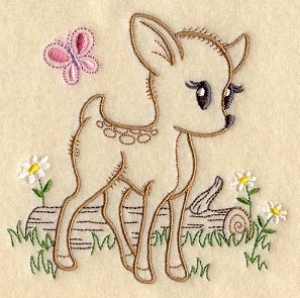
Outline work is a form of embroidery, in which only the outline of the design or pattern is stitched. The rest of the design is left ‘bare’, showing the ground material, or sometimes an applied piece of cloth. The stitches that are often used to work this style of embroidery include back stitch, chain stitch, outline stitch and stem stitch.
Overcast Stitch

The overcast stitch is a basic technique that can be worked in several ways. The simplest form is where an outline is drawn on the ground material and then small, simple stitches (the overcast stitches) are worked over and under the line, picking up the smallest amount of ground material as possible and making sure that the stitches lie vertically next to each other in order to create a slightly raised line.
Cordonnet Stitch
Whipped Running Stitch

A whipped running stitch is used with a line of running stitches that are whipped with the same or a contrasting thread. The needle creating the whipped running stitch does not enter the ground material at all.
Whipped Stem Stitch
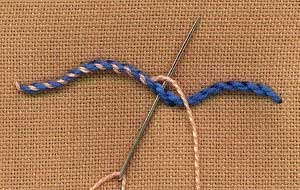
A whipped stem stitch normally consists of a line of stem stitches that have been whipped with the same or a contrasting thread. The needle creating the whipped stem stitch does not enter the ground material at all.
Quaker Stitch
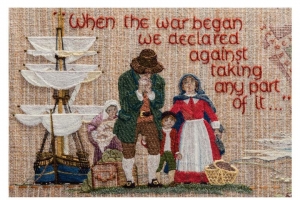
The Quaker stitch was invented by Anne Wynn-Wilson while designing and embroidering the Quaker tapestry. She describes it as a form of corded stitch.
Maia, Elisa Hirsch
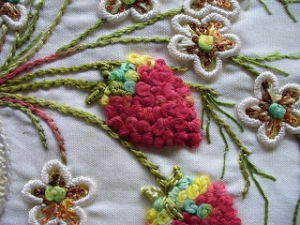
Elisa Hirsch Maia (often known as Madam Maia) was a Brazilian embroiderer and entrepreneur, who is credited with developing Brazilian dimensional embroidery. Maia was a skilled needle woman who embroidered all her family’s linen and clothing. She began experimenting with flosses and dyes in the 1960's in order to develop a smoother thread and new colours.
Tetouan Gold Embroidery (Morocco)
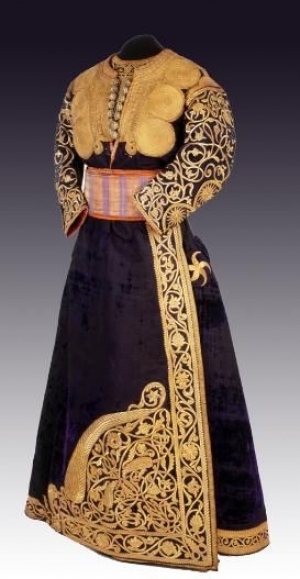
In the nineteenth and early twentieth centuries, the Jewish women of Tetouan, Morocco, were famous for the production of gold embroidery. Normally this embroidery took the form of stars or circles worked with gold thread, which were applied to a cloth ground material. These decorated textiles were often used for curtains and hangings in silk and velvet. Tetouan Jewish women sometimes wore velvet dresses decorated in the same manner.
Tetouan Embroidery (Morocco)
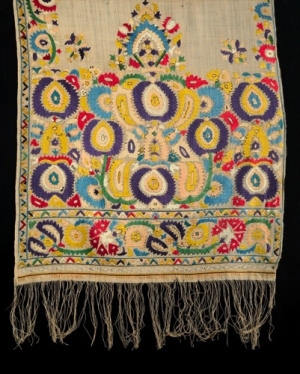
Tetouan is the only open port of Morocco along the Mediterranean Sea. It lies a few km south of the Strait of Gibraltar and about 60 km from Tangier. The present city of Tetouan was founded in the early fourteenth century and it soon became a prosperous trading port. Tetouan embroidery is known for its distinctive character, with stylised flowers and geometric shapes in bright colours.
Berber Women's Coverings (Morocco)
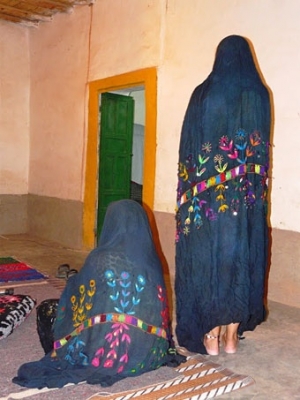
Some groups of Berber women in Morocco wear a large covering called a tahruyt. The embroidered cloth is normally placed over the head and upper body and then one end is draped over the left shoulder.