

The Wrongs of Woman, by Charlotte Elizabeth Tonna
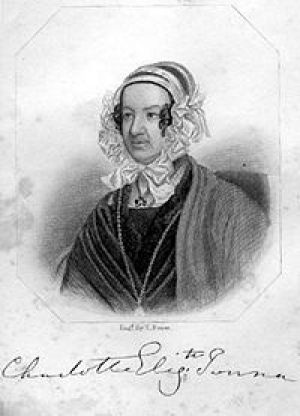
The Wrongs of Woman is a nineteenth century novel by the English writer, Charlotte Elizabeth Tonna (1790-1846; she wrote as Charlotte Elizabeth), about the life of lace embroiderers in England. Tonna wrote several books on the contemporary social and economic conditions of women.
Lace Runner
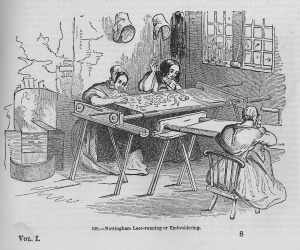
The term lace runner can be used in different ways. It was, for example, a nineteenth century English term for a person who hand embroidered lengths of machine net with darning stitches or running stitches. The term can also be used for strips of net or cloth, such as linen decorated with lace or embroidery of some kind. These were intended to run down, for instance, a table centre. Sometimes these strips are mistaken for stoles.
Drawn Linen Work
See Hardanger embroidery.
Drizzle Stitch
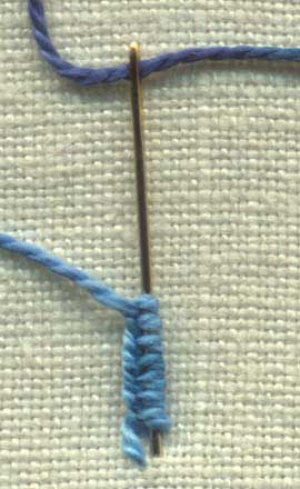
The drizzle stitch creates a form of knot comparable (but not identical) to a bullion stitch (bullion knot). The drizzle stitch is used in Brazilian dimensional embroidery.
Stab Stitch
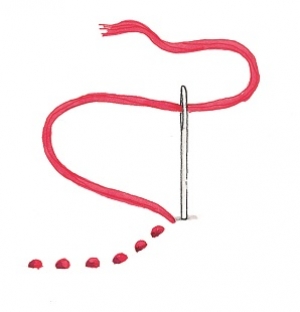
The stab stitch is often used in couching or laid work. The thread goes up, over the thread to be held in place, and then down through the same hole. The thread then passes along the reverse side of the ground material to the position of the next stitch.
Laid Thread
A laid thread is the thread that is placed onto the ground material and fastened down with the couching threads and stitches, producing a form of couching.
Bayeux Stitch
See laid work.
Tying Down Stitch
See laid work.
Laid Work

Laid work is a form of embroidery that is very closely related to couching. Laid work normally has three or more layers of thread (while couching normally has two layers of thread).
Outline Embroidery
See outline work.