

Stringwork
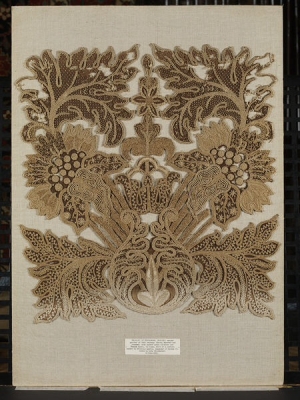
Stringwork was a popular form of decorative needlework in seventeenth and eighteenth century Europe. A thin, round cord was wound onto a large shuttle with open ends, then the cord was unreeled and knots made at intervals. The resulting knotted cord was fed into a bag, suspended either at the left wrist or from a belt. The knotted cord was then couched down in a decorative pattern onto an usually linen ground of some kind.
Lacemaker
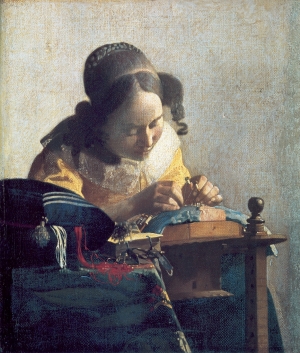
A lacemaker is a general term used to describe someone who makes hand or machine lace. With respect to the hand lace forms, the term is mostly used for someone who makes bobbin lace, rather than, for example, needle lace.
Sample
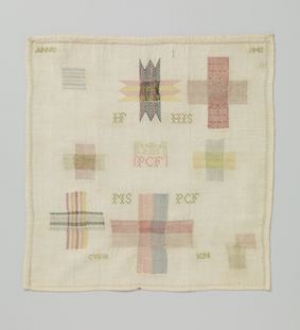
In decorative needlework, the word sample is used to describe a simple or randomly worked form of sampler. The intention of making a sample is to try out various techniques, designs or lay-outs, or to remind the worker of the technique and/or patterns, or to show them to a few others.
Point de Riz
See rice stitch.
Raf-Raf Bridal Outfits (Tunisia)
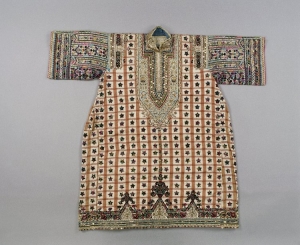
Raf-Raf is a town on a headland southeast of Bizerte, Tunisia. It is famous for its embroidered bridal costumes, especially the tunics and waistcoats. The wedding wardrobe of the Raf-Raf women consists of several types of outfits worn on different days.
Raf-Raf Suriya Mabdu (Tunisia)
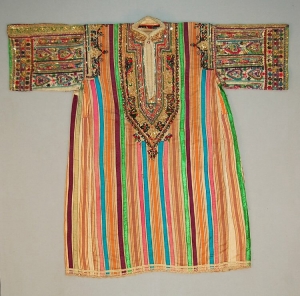
Raf-Raf is a small town, southeast of Bizerte, Tunisia. It is famous for its regional bridal costume and its everyday tunic or chemise for women (suriya mabdu). This latter style of dress was still being worn at the end of the twentieth century, but its use is rapidly dying out. The suriya mabdu is made in various forms. Basically, it is a rectangular garment, previously of linen, now of cotton, with a decorative plastron.
Raf-Raf Embroidery (Tunisia)
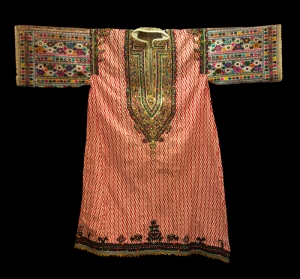
Raf-Raf is a small town on a headland southeast of Bizerte, Tunisia. It is famous for its embroidery. The embroidery is used for its elaborate, everyday tunics for women (suriya mabdu) and for the elaborate regional Raf-Raf wedding outfit. The evolution of the Raf-Raf costume has been described by the Tunisian costume historian, Aziza ben Tanfous, in Les Costumes Traditionnels Feminins de Tunisie (1978:60, pls. 13-17).
Mercerised Cotton
See mercerisation.
Mercerisation
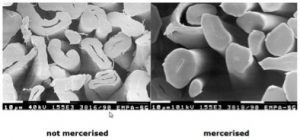
Mercerisation is a treatment of raw cotton or cotton yarns. The individual fibres are made to swell in a strong alkaline, which is afterwards neutralised in a special acid bath. This process causes the fibres to permanently swell, which straightens and strengthens them while giving them a shiny or lustrous appearance.
Assuit Work (Egypt)
See tulle-bi-telli.