

Smocking
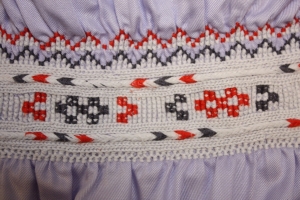
Smocking is a decorative technique consisting of the gathering together in regular folds of a wide width of material. Sometimes the term 'honeycombing' is used for this type of work, after a popular smocking pattern called 'honeycomb'. Smocking is used to control the fullness of a garment, especially around the sleeve cuffs, bodice, shoulders, as well as in the front and back neckline, leaving the material following these areas free and loose fitting.
Wallachian Embroidery (2)
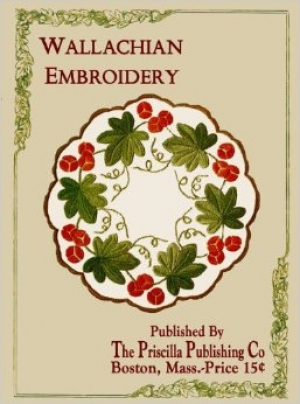
Wallachian embroidery is a form of whitework embroidery that became popular at the end of the nineteenth century in North America, and should not be confused with the 'original' Wallachian work. Its characteristic feature is the use of buttonhole stitch. It was based upon a traditional embroidery style from Wallachia in Romania. The urbanised American version is mainly worked in white silk or cotton on a linen ground.
Wallachian Embroidery (1)
Wallachian embroidery is a solid, multi-coloured form of decoration from Wallachia, in what is now Romania.
Slavekoorde-Braunstahl, Henriëtte (1885-1983)
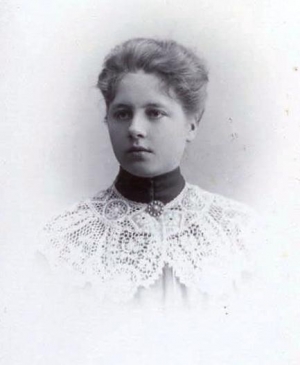
Henriëtte Slavekoorde-Braunstahl from Den Haag (The Hague; 1885-1983), The Netherlands, was a student at the Industrieschool voor Meisjes ‘s-Gravenhage [The Hague]) between 1899 and 1904. She received her diploma as a handwork teacher in 1904. Henriëtte Slavekoorde-Braunstahl was particularly talented and later was to make items for the Dutch royal family.
Quilting

Quilting is a sewing technique whereby two or more layers of cloth are sewn together to make a thicker structure, often called a quilt. Quilts usually, but not always, have a padding material (wadding or batting) of some kind in between two other layers.
Quilt
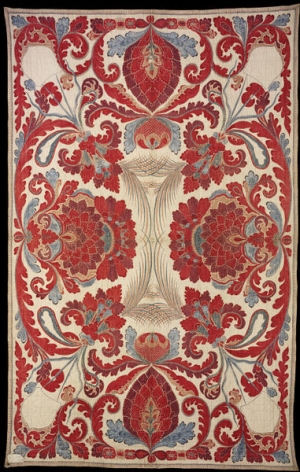
A quilt is a bedcover or coverlet normally made from two layers of cloth with a layer of raw or woven wadding in between. The top layer of a quilt (from the Old French coilte, Latin culcita, 'mattress' or 'cushion') may be made of a single length of material, or two or more pieces sewn together, often using a patchwork technique. The bottom layer usually consists of a plain length of cloth.
Embroidered Net Lace
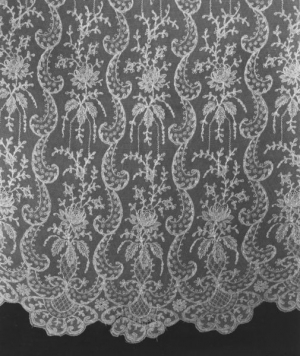
Embroidered net lace is a needle lace form, which developed in Europe from about the fourteenth century onwards. There are two main forms of embroidered net lace, depending on the type of net being used, namely a hand knotted net ground (filet), or a machine made net ground (tulle or bobbinet), both with a stitched design.
Needlepoint Lace

Needlepoint lace is a needle lace form of lace, whereby a ground material is no longer an essential part of the finished product or indeed it is completely absent. Needlepoint lace can be described as a single-thread technique using embroidery stitches. In general, the main stitch used for needlepoint lace is buttonhole stitch. The basic techniques of needlepoint lace, roughly following its development, can be distinguished as follows:
Floss Silk

Mahmal

The mahmal is an embroidered palanquin (a form of travelling tent), specifically associated with the (symbolic) transport of the kiswa, the covering of the Ka`aba in Mecca, Saudi Arabia. A mahmal in its more general meaning was a covered construction perched on the back of an animal, usually a camel, and used to carry people, especially noble ladies and brides, who required a degree of privacy.